Showing posts with label Japonisme. Show all posts

Sunday, April 3, 2011

Reorientation: The Orient Expressed at the Mississippi Museum of Art


“Disorientation is lost of the East,” novelist Salman Rushdie has written, reminding us of the original meaning of “Orient.” In The Orient Expressed: Japan’s Influence on Western Art, 1854-1918, which runs at the Mississippi Museum of Art through July 17, 2011, the curators hope to reorient us to the term Japonsime so that we can find the East, or more accurately the East of the 19th century West, lost over time. The sense of wonder over the new world of Japan suddenly opened up in 1854 is something we today could only experience if life were found on Mars. In the catalog and exhibition itself, Japan, currently reeling from disaster, reemerges as the rich land of culture and style so influential on Western art and design. It’s a reorientation course we in the West can’t do without. Please come over to Picture This at Big Think to read more of "Reorientation."

[Image: Paul Gauguin (French, 1848–1903), Still Life with Onions, Beetroots and a Japanese Print, 1889. oil on canvas. 16 x 20.5 in. Collection of Judy and Michael Steinhardt, New York, New York.]

[Many thanks to the Mississippi Museum of Art for providing me with the image above and press materials for the exhibition The Orient Expressed: Japan’s Influence on Western Art, 1854-1918, which runs through July 17, 2011. Many thanks also to the University of Washington Press for providing me with a review copy of the catalog to the exhibition.]

Monday, August 3, 2009

Your Moment of Zen

Tom Killion, Mt. Tamalpais From Mill Valley Marshes, 1980 (9 x 12)

Part of the fascination of Japanese prints is that you envy the Japanese way of living with nature and wish you could somehow import that Zen into your own life and national culture. Artist Tom Killion and poet Gary Snyder’s Tamalpais Walking: Poetry, History, and Prints from Heyday Books offers a Japanese import that we can unashamedly use to transport our souls out of the drudgery of American capitalism run amok. Marrying Killion’s Japanese-inspired woodblock cuts (above and below) with Snyder’s Zen-infused verse, Tamalpais Walking guides us to the foot of Mount Tamalpais overlooking the teeming Bay City area and makes us feel that we’re actually there, ascending the peak with them. “We who bestow names, who imagine the world from within our human selves,” Killion writes, “what meaning shall we give this beautiful place?” The simplicity of Killion’s images and Snyder’s words opens doors through which we can venture and give our own personal meaning to this place, which resides as much on the Pacific Coast as in the imagination of anyone who reads this book.

Tom Killion, Bolinas Ridge to Duxbury Point, 2004 (14 x 18.5)

In 1965, Snyder, along with fellow poets Allen Ginsberg and Philip Whalen, founded a circumambulation route around Mount Tamalpais that could be completed in a single day. Snyder had roamed about the mountain since 1948 and wove many of his experiences there into his poetry. In his poem “Hills of Home,” Snyder writes:

to see your own tracks climbing
up the trail that you go down.
the ocean’s edge is high
it seems to rise and hang there
halfway up the sky.

Snyder’s essay in Tamalpais Walking, titled “Underfoot Earth Turns,” tenderly caresses the land with verbal imagery. Walking among the “strict and thoughtful old trees,” Snyder has come to see Tamalpais as “no longer just a playground or a gateway, but a temple and a teacher, a helper and a friend.” In the end, Snyder asks, “Did we make up that great space, or did it make us up?” Snyder’s soulful appreciation of Mount Tamalpais mirrors that of many great visual artists who find infinity in a single spot, such as Cezanne and Mount Sainte-Victorie or Andrew Wyeth and Chadds Ford. I couldn’t help but think of Thoreau at Walden Pond when reading of Snyder’s obsession with the mountain, especially in the way that both Thoreau and Snyder strive to wake the sleepers around them to the beauty without and within. “If you look, you’ll find a way,” Snyder writes of Tamalpais and, by extension, life.” “A path, a trail, an old road… it’s about discovering mobility, independence, choice, and places to hang out in the underbrush. It’s about getting there on your own two legs.” Snyder declares independence from the American rat race and encourages us to slow down, look around, and live, too.


Tom Killion, Mt. Tamalpais From Above Green Gulch (Coyote Ridge), 2002 (13 x 19)

Just as Snyder presents Tamalpais as a poetic microcosm of what America can be, Killion presents Tamalpais as a microcosm of American history, both good and bad. Tamalpais, the “sleeping lady” of the Bay Area, took it’s name from the local Miwok tribes. When Europeans settled the area and drove the Native Americans out, they kept the name of Tamalpais. The German immigrants who arrived in the 1880s and became the largest immigrant group in the area at the time transplanted their European hiking culture to Tamalpais and searched every inch of their new prize. Some of the earliest conservationists sought to save Tamalpais’ pristine beauty. “An American Wordsworth will one day come to sing these noble trees,” conservationist William Kent predicted in 1908. Killion traces the long line of poets leading up from the mid-19th century to Kenneth Rexroth in the 1930s to Snyder and the Beats of the 1950s and 1960s. Painters and photographers, most notably Ansel Adams, also brought their art to Tamalpais. Sadly, in the 1940s, Tamalpais witnessed the persecution of the local German population and the internment of Japanese citizens during World War II. Killion aptly positions Tamalpais as a wise witness to all these glories and tragedies in American history.
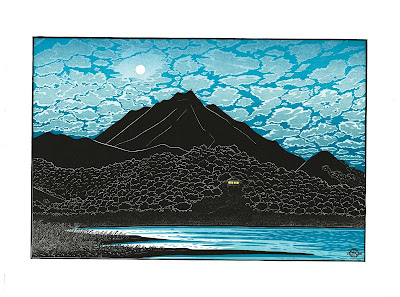

Tom Killion, Mt. Tamalpais, Marin County, 1996 (11.5 x 17)

Killion takes his rightful place among the great artists who have paid homage to Mount Tamalpais with his insightful and inspired images. Only eight years old when he first hiked Mount Tamalpais in 1961, Killion has studied its sides ever since. The art of Hiroshige and Hokusia, the twin towers of classic Japanese printmaking, inspired the young Killion to follow a similar approach to his personal peak. Killion’s 1975 book 28 Views of Mt. Tamalpais directly referenced Hiroshige’s Thirty-Six Views of Mount Fuji without slavish devotion but, instead, true homage. The Zen spirit of Hiroshige and Hokusai comes through clearly in works such as Killion’s Mt. Tamalpais, Marin County (above, from 1996). The single light shining through the window of the mountainside home hints at the human presence surrounding Tamalpais while simultaneously conveying how the dark, brooding shape dwarfs mere humanity. Killion’s works always stand in awe of nature. “Just a mountain,” Killion writes ironically of Tamalpais, “but fixed in the imagination of a city.” Killion’s art fixes Tamalpais panoramically into the imagination of anyone who can be open to the love and spirit behind them.


Tom Killion, The City From Mt. Tamalpais, 1979 (5 x 7)

Killion and Snyder’s art forms pair together like the perfect wine and food, composing a nourishing meal for the shrinking soul. “May we all find the Bay Mountain that gives us a crystal moment of being and a breath of the sky, and only asks us to hold the whole world dear,” Snyder prays as a closing benediction to readers of Tamalpais Walking. As much as Killion and Snyder and so many others hold Mount Tamalpais dear, the real message of Tamalpais Walking is for us to “hold the whole world dear” and find our own mountain to stand upon and see the world and ourselves fully, perhaps for the first time.

[Many thanks to Heyday Books for providing me with a review copy of Tom Killion and Gary Snyder’s Tamalpais Walking: Poetry, History, and Prints and for the images from the book.]

Monday, May 25, 2009

Rub a Dub Dub


Any parent will tell you that one of the most “interesting” parts of their day is bath time. Thanks to a small armada of toy boats, Mr. Bubble, and assorted other tricks, Alex usually enjoys his bath time. After pulling my slippery three year old from the suds and wrapping him up in a dry towel, I sweep him up in my arms and hold him close to keep him warm. For that brief moment, he’s our little baby again. Although never a parent herself, Mary Cassatt painted many scenes of mothers and children during bath time. Born May 22, 1844, Cassatt met Edgar Degas and worked closely with him. Degas’ interest in the female nude in a bath setting may have spurred Cassatt’s interest in her own bath pictures, which have a more acceptably “female” approach in the motherly relationship between child and parent. Cassatt’s The Bath (above, from 1891-1892) shows the early style of Cassatt, not yet fully Impressionist yet no longer entirely the strict realism of her PAFA training. Around the time of this painting, Cassatt saw an exhibition of Japanese prints as part of the larger Japonisme fad of the age. Elements of Japonisme appear in The Bath in the diagonal of the child’s body crossing against the near diagonals of the mother’s striped dress. The flatness of much of the color also shows the influence of Japanese prints. In addition to all these styles straining against each other simultaneously, Cassatt tenderly depicts the intimacy of the mother and child at the moment that the child is the most vulnerable.


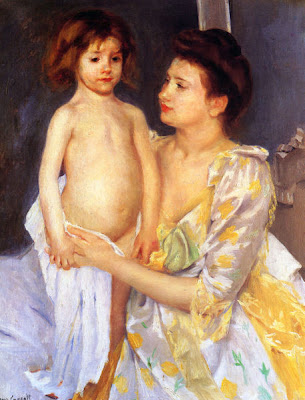
In Jules Being Dried by His Mother (above, from 1900), Cassatt depicts the next stage of the process. Degas loved to show women after the bath, especially during that awkward transition from water to dry ground. Little Jules here looks straight ahead while his mother’s eyes lock on his face with affection. In this painting, the intimacy seems almost one-sided. Cassatt paints their disconnect rather than a connection here. Little Jules is not so little anymore. He seems ready to do things for himself. Jules’ expression shows almost a kingly tolerance of his mother drying his limbs. The elaborate dress of Jules’ mother appears almost courtly rather than realistic, adding to the regal indifference of princely Jules. (I personally prefer a t-shirt and running shorts when administering ablutions.) Stylistically, Cassatt begins to turn more Impressionist. Jules Being Dried by His Mother shows an almost Renoir-like softness in the modeling of faces and bodies, an interesting divergence from the influence of Degas. Although unrealistic, the pattern of yellow and white as well as the shimmering highlights of the mother’s dress make it the star of the painting.


In After the Bath (above, from 1901), Cassatt copies the gestural pastel technique of Degas in the parallel lines that make the picture almost seem to move. Degas allowed himself to grow bolder and bolder in this technique to the point that the bathers or dancers in the work became almost superfluous to the technique. Cassatt, however, continues to center the image on the relationships of the subjects. In After the Bath, Cassatt returns to the intimacy of mother and child, but with the added twist of a love triangle formed by the presence of an older sibling. Sigmund Freud and his idea of sibling rivalry developing from the Oedipus complex were not yet mainstream ideas, but any student of human nature such as Cassatt instinctively knew that siblings will fight among themselves for more face time with parents. Is the older child’s grip on the baby’s wrist a gesture of affection of an attempt to break the contact between baby and mother? The painting doesn’t offer any clues as to motivations or final outcome but does allow for the possibility of connection or conflict. As a woman, Cassatt felt limited in her range of subjects. Painting in the acceptable genre of bath time, Cassatt could subversively explore avenues in the human heart that exist at every age.

Thursday, November 6, 2008

Language Immersion


Some people believe that the best way to learn a foreign language is language immersion, the method by which a person tries to operate entirely in a second language. Such immersion stretches the mind to actually think in that second language and make the leap from simply translating everything mentally from their mother tongue. When European artists of the nineteenth century began to encounter the world of Japanese prints, they immersed themselves in that second visual language and stretched themselves artistically to incorporate that wholly alien look into their work. It’s difficult for us today to imagine that initial impact of Japanese art on Western art, but two new books edited by Nobuyoshi Hamada, Wave, Cloud, Pine: Traditional Patterns in Japanese Design and Flower, Bird: Traditional Patterns in Japanese Design (published by PIE Books and distributed in the United States by Rizzoli Books), help recapture the diversity and seemingly endless inventiveness of those Japanese artists that found a place in the souls of artists such as Vincent Van Gogh, Paul Gauguin, and countless others. Oddly wonderful works such as Utagawa Kunisada’s Catching a Giant Carp—What Luck! (above, early 19th century) opened up a whole new range of possibility for Western art as Japanese society itself opened itself up to the West.


Unfortunately for those who do not read Japanese, these two volumes contain very little English text. But in one of the few extended passages in English, Hamada explains the appeal of the Japanese approach to nature in art. “The wisdom of past generations lay in capturing this beauty in paintings and craft objects, so to be incorporated into everyday life, enjoyed, and cherished,” Hamada writes. “Unlike Western art, which treats nature as menacing and adversarial, the art of the East pursues harmony with nature and focuses on humanity’s perceptions of the natural world.” When Ito Jakuchu paints The Colorful Realm of Living Beings: Hydrangeas and Fowls (above, 1759), he elevates flora and fauna to the level of humanity, integrating Buddhist and Zen abstract concepts with concrete nature. For someone with the sensibility and sensitivity of Van Gogh, such works represented the world inside his head and heart that his hands still struggled to realize visually. Perhaps better than any missionary, these traditional Japanese designs conveyed the truths of Buddhism and Zen to Western audiences looking for an alternative to the Christian tradition tainted by centuries of politics and warfare.


Hamada breaks up the two volumes into the five categories of wave, cloud, pine, flower, and bird and entrances you with repetition. Between stunning color reproductions, Hamada intersperses preparatory drawings in fine detail that place the technique of the artists under a microscope. Right after seeing how an artist represents a wave’s motion in color in the context of a painting, we see the pure line itself in black and white. Hamada isolates the gesture and focuses on the human element in representation, specifically how the artist sought to reproduce the spirit of the wave and not the photographic reality. Katsushika Hokusai’s The Great Wave off Kanagawa, which Hamada includes in his examination, looks like no wave ever seen by human eyes, yet the biting fierceness of a wall of water strikes us through Hokusai’s gestures better than via any snapshot. Once you get the visual language down, Hamada guides you through the multiplicity of uses Japanese artists put it to. Japanese prints may lead the wave of Japonisme in the Western mind, but Hamada proves that the gestures of those prints ripple throughout Japanese culture to furnishings, kimonos, pottery, postcards, and even photography. Even the patterns of rock gardens contain the elements of traditional wave patterns. Examples such as the wave pattern found in the Undulating Bargeboard of the Gokonomiya Shrine (above) demonstrate how these motifs reach every corner of Japanese life. Such integration just can’t be found in Western civilization, which may explain not only our historical disintegration and our fascination with the East.


As I paged through these works, I found myself reverse engineering so many works of Western artists into the Eastern images before me, consciously going against the grain of influence. When I saw Gan Ku’s Tiger (above, late 18th century), my mind immediately flashed to Franz Marc’s Tiger. Marc doesn’t copy Gan Ku’s animal and may never have even seen anything by the Japanese artist, but the same spirit of the animal itself shines through both works. The preparatory drawings with their distinctive lines reminded me of the drawings of Van Gogh, whose draftsmanship seemed so “wrong” to contemporaries yet seems so right to us today. There’s certainly a danger in trying to link these traditional Japanese patterns to their implementation in Western art, but there’s also a benefit in seeing just how deeply those motifs have taken root in Western visual culture since the late 19th century. Influence is often such an elusive trail to follow that such clear and documented lines of descent as the effect of Japanese art on Van Gogh’s generation is an irresistible path of research.


The lack of English text actually benefits a non-Japanese reader in some ways. The lack of verbal explanation frees the reader to surrender himself to the images themselves. Allowing the sequences of images to pass and engrave themselves on your imagination through repetition, you will find yourself inspired by these motifs and the artists that practiced them. Startling variations, such as the stylized, almost modernly abstract clouds of Tosa Misufumi’s Amanohashi (above, from 1855), will open your eyes to the amazing inventiveness of these artists working within an ancient tradition. Nobuyoshi Hamada’s two volumes of Traditional Patterns in Japanese Design are an ideal gift for any young artist learning how to see the world and shape an individual vision from a universe of possibilities.

[Many thanks to Rizzoli Books for providing me with review copies of the PIE Books titles Wave, Cloud, Pine: Traditional Patterns in Japanese Design and Flower, Bird: Traditional Patterns in Japanese Design and for the images above.]

Thursday, October 23, 2008

Island Hopping


Fleeing the turmoil of the 1917 Russian Revolution, David Burliuk, the “Father of Russian Futurism,” gathered together his family (above) and set his sights on the safety of the United States. Unable to emigrate directly to America, however, Burliuk first moved to Siberia and then to Japan. While in Japan, Burliuk exhibited his work to a Japanese audience that had never seen firsthand modern European painting or a modern painter such as Burliuk. Michael Craig and Copernicus Films examine this strange interlude in the artist’s exodus in the film David Burliuk and the Japanese Avant-garde. Craig examines both Burliuk’s influence on the Japanese avant-garde as well as the influence of Japanese art and culture on Burliuk himself. Burliuk arrived in Japan just as that closed culture began to open itself up to the ideas of the West. For Japanese artists coming to grips with a world shifting beneath their feet, Burliuk provided an example of how to steady yourself and find a new place in an uncertain, new world.


Unlike Craig’s other films in his series on the Russian avant-garde, such as Alexander Rodchenko and the Russian Avant-garde (reviewed here) and Architecture and the Russian Avant-garde (reviewed here), David Burliuk and the Japanese Avant-garde leaves Russia and the Russian Revolution’s aftershocks behind for the relative calm of Japan. Burliuk found great success in Japan, beginning with his exhibition titled “The First Exhibition of Russian Painting in Japan.” A member of Japan’s imperial family came to the show and even bought one of Burliuk’s paintings. As Japan got to know Burliuk and Futurism, Burliuk engaged himself fully with the subtleties of Japanese culture and art. Burliuk’s cultural immersion results in almost Impressionistic works such as his Kyoto Temple (above) that departed radically from the more radical style his new Japanese audience knew him best for. Like so many European artists fascinated with Japonisme who incorporated that style into their art, Burliuk internalized the Japanese art surrounding him but even more so by seeing it fully in context and not through prints and paintings alone. The footage of modern day Japan in all its colorful vibrancy makes it clear just how powerful an effect it could have on the artistic imagination of someone as open to new experiences as Burliuk.


Of all the nineteenth century artists who adapted Japonisme to their art, Paul Gauguin inspired Burliuk the most. When Burliuk took his family to a vacation on the island of Ogasawara, the Japanese equivalent of Hawaii, Burliuk recreated the pilgrimage of Gauguin to Tahiti that freed Gauguin’s artistic soul. Burliuk traveled all over Ogasawara in search of beautiful vistas to paint (above). In addition, Burliuk learned Japanese by speaking with the local fishermen and came to appreciate their simple way of life. For me, the section showing the beauty of Ogasawara was the highlight of the film. Craig and company capture all the magic of that tropical paradise visually while the narration fully connects the love triangle formed between Burliuk, Gauguin, and Ogasawara. After painting on the island for several months, Burliuk returned to mainland Japan and exhibited his landscapes, which surprised and, sometimes, disappointed audiences expecting more Futurism from the touted “Father of Russian Futurism.” However, Craig calls this period in Burliuk’s career “a summing up of where he’d been” and “a step back to step forward.” Reenergized and refocused by his island idyll, Burliuk rediscoved the social purpose of his art in Japan just before leaving for America. As the Japanese translator of Burliuk’s writings notes in the film, Burliuk’s early books written in Russia seem heavily weighted with the gloom of political events, whereas the books written during his stay in Japan shine with a sunny view of the future. Titling one of those Japanese books “What Is Futurism? An Answer,” Burliuk seemed confident that answers did indeed exist in a rational world.


Japanese artists such as Tomoyoshi Murayama (shown above with his wife) and Kinoshita Shuichiro took Burliuk’s answers and tried to translate them into a language that could address their cultural concerns. Craig succinctly yet compellingly outlines the social situation of Japan between the wars as a nation with an identity crisis, caught between an ancient insular tradition and the pressing need to join the rest of the globe. Young Japanese artists following Burliuk’s example soon came into conflict with the established Japanese art world. Like the Russian avant-garde, the Japanese avant-garde viewed art as a means of social revolution and used technology as the means of combining commerce and art. The Great Kantō earthquake of 1923 that devastated Tokyo provided these young artists with an opportunity to remake the rebuilt city in a modern way to reflect the next stage of Japanese culture and society. Using archival footage, Craig and company recreate that moment in Japanese history when old and new clashed and avant-garde art stood at the center of it all.


To Western eyes, Asian art often seems a monolithic parade of ancient styles endlessly recycled. David Burliuk and the Japanese Avant-garde reveals how the same concerns that rocked European societies also unsettled the Asian world. Burliuk’s travels allowed him to cross-pollinate the Japanese avant-garde with the earlier example of Russia’s progressive art movement. After Burliuk sparked Japanese artists into action, they set a raging bonfire of activity, including the Sanaka Exhibition (above) as well as forays into theater and dance that modernized the ancient traditions of Kabuki and Noh. A visually amazing film as well as a whirlwind tour through early Japanese modern art and the life of David Burliuk, David Burliuk and the Japanese Avant-garde will set you off on your own voyage of discovery to learn more about this amazing crossing of paths.

[Many thanks to Michael Craig and Copernicus Films for providing me with a review copy of David Burliuk and the Japanese Avant-garde and for the images from the film.]