Showing posts with label Pennsylvania Academy of the Fine Arts. Show all posts

Thursday, September 3, 2009

Close Shave

Sidney Goodman. Night Vision, 1993-94. Charcoal and pastel on paper. 60 x 52 inches. Collection of Joseph and Patricia Connolly.

“While art is not always an emotional enterprise, it is absolutely consumed with life and death matters for [Sidney] Goodman,” writes Mark Rosenthal in the catalogue to Sidney Goodman: Man in the Mirror, “as if he, upon a time, dedicated himself to the dangerous mantra of Eros-Thanatos.” In the exhibition of the same name at the Pennsylvania Academy of the Fine Arts, Goodman’s life and death obsession comes across in 60 drawings and watercolors in mostly black and white with the occasional touch of stunning color. Perhaps no other work encapsulates the Eros-Thanatos theme as neatly as Night Vision (above, from 1992-1994), which pairs figures of love and death on the page as closely as in life. As curator Julien Robson points out in his essay, Night Vision and other works display Goodman’s exploration of the theme of the classical sculpture of Laocoön and His Sons, in which serpents sent by the gods strangle a priest and his sons for sniffing out the ruse of the Trojan Horse. “Illuminated in the flash of the artist’s imagination,” Robson continues, “the combination of material drawn from observation and memory is synthesized into a form that has a dream-like discontinuity that co-mingles the real with the imaginary.” A teacher at the PAFA since 1979, Goodman teaches us art history with a twist by throwing the classical, baroque, symbolist, and figurative traditions, along with many others, into the blender of his vision. Looking at Night Vision, you recognize Fuseli, Blake, Goya, and others, but you never lose sight of Goodman.


Sidney Goodman. Child Near Source, 1987-88. Charcoal and pastel on paper. 35 x 44 inches. Collection of the artist.

Robson believes that Goodman’s move from the suburbs to Philadelphia is a key to his art. “In this transition the task of expressing the tensions of a listless existence gave way to a vital engagement with the passions and a reinvigorated investigation of the self,” Robson writes. Reversing white flight, Goodman hurled himself and his family into urban existence red in tooth and claw rather than wallow in the enervating safety of the ‘burbs. Child Near Source (above, from 1987-1988) originates from a photograph of one of Goodman’s children standing beside a tree in Rittenhouse Square in Center City Philadelphia. The expression on the child’s face as he looks back at his father or mother captures just how alien nature feels to him—a stand-in for the modern disconnect from life’s sources. The vulva-esque opening at the base of the tree stump adds a sexual dimension, as if the child wishes to return to the womb but wants to know how. Goodman makes use of candid photographs of his wife and children in many of the works in the exhibition not as sentimental fodder but as a springboard to deeper messages. “Goodman’s wit… unearths a residue of ambiguity that transforms these pictures from simply being meditations on domestic bliss into visually puzzling studies of familial relationships,” Robson remarks.


Sidney Goodman. The Birthday, 1988. Pastel and charcoal on paper. 90 x 61 inches. Collection of the artist.

In The Birthday (above, from 1988), Goodman poses his son as a devilish child, complete with horns thanks to a pair of birthday hats, cavorting in his “birthday suit.” Even in such childish themes Goodman manages to mix the everyday with both sex and danger. For Goodman, violence is childish and even cartoonish. In Mickey Watches, a leering Mickey Mouse witnesses the brutal beating of a man. A small drawing of The Three Stooges helps the viewer draw the conclusion that violence is both grotesque and comic in the baroque sensibility. It is in many of these depictions of violence that Goodman employs sparing yet stunning use of color. “So thoroughly is his work an art of black and white, especially in drawing,” Rosenthal writes of Goodman, “that it explodes when pastel suddenly appears.” Flashes of red representing bloodshed flame out from the image and burn into your memory with their selectiveness more than any painted bloodbath possibly could. I walked through the exhibit right after viewing Elizabeth Osborne: The Color of Light, another PAFA exhibition (my review here) running at the same time just downstairs from the Goodman show. Both teachers at the PAFA and both great artists in the figurative tradition, Goodman and Osborne demonstrate the entire gamut of emotions that color, either liberally flowing or selectively dripped out, can achieve. Each exhibition is moving by itself, but the combined effect will quite literally knock you off your feet.


Sidney Goodman. The Artist's Mother II, 1994. 47 1/2 x 33 1/2 inches. Charcoal and pastel on paper.

Goodman excels at manipulating imagery and motifs for different effects. In Night Vision, the Laocoön reference calls upon ideas of Eros and Thanatos. In The Artist’s Mother II (above, from 1994), the Laocoön tendrils reach out again as harbingers of death, but the passionate violence of eros gives way to the tenderness of agape as the tendrils extend to embrace rather than strangle the artist’s mother, who was dying at the time. The tree limbs serpentine around the elderly woman’s body as if accepting it back into nature, returning her to the mysterious source that mystified Goodman’s son in Child Near Source. Goodman draws his mother with the frizzy hair and chubby features of reality leaning against the wheelchair that became her final means of conveyance and conveys her as stunningly beautiful and alive at the very moment she is dying. As with the drawings and paintings of his children and wife, Goodman rejects the conventional definitions of beauty and redefines them as reality viewed intensely and imaginatively. His wife Pam shown sleeping or combing a child’s hair is not a fantasy woman but a real woman with all the flaws and perfections real women claim as their true charms.


Sidney Goodman. Man in the Mirror, 1987-88. Charcoal and pastel on paper. 22 x 30 inches. Collection of Malcolm Holzman.

Goodman also repeatedly turns his eye to himself. A series of works showing the artist shaving called Man in the Mirror (one above, from 1987-1988) jokingly presents the mundane reality Goodman faces each morning. The receding hairline and broadening features that come with age are an honest man honestly looking at who and what he is. I think of Thomas Eakins’ warts-and-all 1902 Self-Portrait as a precursor of Goodman’s self-portraits, and I’m sure Goodman is aware of Eakins, too. Funny enough, Eakins’ portrait shows the signs of a poorly performed shave, but Goodman’s works all demonstrate his gift with the blade. Goodman cuts close to the skin in his art and shows us what lurks beneath while spilling as little blood as necessary. In this black and white hall of mirrors, such dabs of blood always remind us of the human passions flowing beneath.


[Many thanks to the Pennsylvania Academy of the Fine Arts for providing me with a review copy of the catalogue to Sidney Goodman: Man in the Mirror and for the images from the exhibition.]

Tuesday, August 11, 2009

Body Consciousness

Elizabeth Osborne. Renae, 1992. Oil on canvas; 60 x 72 in. Sylvia and Norman Salvat.

“In what ways can a contemporary artist show the myriad ways in which the figure relates to, reflects, is shaped by, and engages with the physical, emotional, and psychological aspects of its environment?” Robert Cozzolino, curator at the Pennsylvania Academy of the Fine Arts, asks in Elizabeth Osborne: The Color of Light, the catalogue to the PAFA’s exhibition of Elizabeth Osborne’s stunningly colorful yet still figurative-focused work. First a student at the PAFA and now an instructor there since 1963, Osborne embodies the figurative tradition of the PAFA that stretches back to Thomas Eakins yet reaches forward throughout the twentieth and now twenty-first centuries in nodding towards abstraction’s explosion of color without losing sight of the human form. Osborne’s body consciousness of, as Cozzolino puts it, “refus[ing] to perpetuate the false dichotomy of abstraction versus figuration” allows her to link the human form with abstraction in works such as Renae (above, from 1992). In Renae, the woman’s red hair flames against a dark background symbolizing her dark mood, while the mauve wall on the left stands as pure abstract color and texture. Osborne strives for the best of both worlds and finds it over and over again.


Elizabeth Osborne. Color Field, 2000. Oil on canvas; 52 x 72 in. Dr. Janice T. Gordon.

When Osborne graduated from the PAFA in 1958, Jackson Pollock’s ghostly influence still dripped across the American art scene. Abstract Expressionism reigned supreme. Later, offshoots of Ab Ex such as Color Field painting kept a tight grip on the “new academy” of what was acceptable contemporary art. Osborne looked to artists such as Willem de Kooning and Jasper Johns for a way to remain contemporary yet still true to her training. “From both of these artists,” Cozzolino writes, “she learned ways to incorporate suggestive traces of the body without relying on realist imagery.” In Color Field (above, from 2000), a ghostly female silhouette appears in the pale blue block of color among an almost abstract arrangement of colored shapes that, when visually reassembled, compose the artist’s studio. Alluding to the Color Field painters with her title while simultaneously clinging to the human body, however spectral, Osborne playfully pokes the abstract artists while changing the rules of their game to suit her purposes. “Clearly composed and impeccably designed, Osborne’s compositions filter the intensely observed world through her judicious adaptations of late-modernist strategies, including minimalism and color field painting,” Cozzolino says in praise of works such as Color Field. Seen in person, Color Field strikes the viewer as what Mondrian might have done if he’d just cut loose.


Elizabeth Osborne. The Bridge and I, 1992. Oil on board; 60 x 72 in. Mr. and Mrs. Harry C. Jones, III.

The daughter of an architect and wife of another, Osborne keenly understands the power of modern architecture. Color Field is just one example of abstraction as architecture. In The Bridge and I (above, from 1992), Osborne sets her self-portrait in her Philadelphia studio with the Benjamin Franklin Bridge behind her. Osborne’s birth father designed that bridge, so it stands in for the absent father in a way that both signifies and obscures him. The bridge “bridges” Osborne to her father, yet can never replace him. “Osborne’s eye for the order and open, liberating qualities of modernist architecture bears an uncommon sensitivity,” Cozzolino concludes. In works such as The Bridge and I, Osborne manages to achieve the subtle shades of emotion modern art often accesses through color, yet also taps into the symbolism of bodies (including her own) both present and absent. That connecting “and” of the title suggests union, but Osborne stands alone, with a chilling swath of cobalt separating her from her father’s design. The scarf slung about her self-portrait’s neck alludes to the cold loneliness of the arrangement.


Elizabeth Osborne. Lux I, 2008-09. Oil on wood panel; 44 x 30 in. The artist, courtesy of Locks Gallery, Philadelphia.

Osborne, however, is more than just a figurative painter taken to a new, modernist level. “Landscape and the observation of natural phenomena,” Cozzolino writes, “have inspired Osborne to distill her subjects closest to abstraction.” Lux I (above, from 2008-2009), one of a series of similar works showing the light of a sunrise or a sunset approaches abstraction yet still remains linked to the American Luminist style of Frederic Church and others. Although Cozzolino never raises the name of Rothko, I couldn’t help but think of the tortured Abstract Expressionist, who also looked at Luminism and brought it into modern times. Standing before the three Lux paintings, I felt revitalized, energized, happy, whereas Rothko’s works depress and/or befuddle me with cosmos-sized riddles. Unlike Rothko, you can still imagine the real world in Osborne’s Lux paintings—the sunrise or sunset experienced with a loved one—whereas Rothko ultimately leaves us crushingly alone—dwarfed by the universe. In a way, the body appears even in near-abstractions such as Lux, except that the body in question is your own.

“Perpetually aware of the deep history she has at her back, looking over her shoulder in the studio, she continues to push the limits of her craft and explore the unknown realms of representation,” Cozzolino says in praise of Osborne, whom he has known in an “extended conversation” since 2004. This close affinity allows Cozzolino to make such statements with informed affection rather than baseless corniness. Osborne really is in a fight with the figures of the past, many of whom worked within her living memory. The brawny, brawling boys of the days of Pollock still muscle out much of American art since the middle of the twentieth century, to the sad exclusion of many deserving artists, particularly women. Like Grace Hartigan, Elizabeth Osborne stands toe to toe with giants and earns her time in the arena.

[Many thanks to the Pennsylvania Academy of the Fine Arts for providing me with a review copy of Robert Cozzolino’s Elizabeth Osborne: The Color of Light and for the images above from the exhibition.]

Monday, May 25, 2009

Rub a Dub Dub


Any parent will tell you that one of the most “interesting” parts of their day is bath time. Thanks to a small armada of toy boats, Mr. Bubble, and assorted other tricks, Alex usually enjoys his bath time. After pulling my slippery three year old from the suds and wrapping him up in a dry towel, I sweep him up in my arms and hold him close to keep him warm. For that brief moment, he’s our little baby again. Although never a parent herself, Mary Cassatt painted many scenes of mothers and children during bath time. Born May 22, 1844, Cassatt met Edgar Degas and worked closely with him. Degas’ interest in the female nude in a bath setting may have spurred Cassatt’s interest in her own bath pictures, which have a more acceptably “female” approach in the motherly relationship between child and parent. Cassatt’s The Bath (above, from 1891-1892) shows the early style of Cassatt, not yet fully Impressionist yet no longer entirely the strict realism of her PAFA training. Around the time of this painting, Cassatt saw an exhibition of Japanese prints as part of the larger Japonisme fad of the age. Elements of Japonisme appear in The Bath in the diagonal of the child’s body crossing against the near diagonals of the mother’s striped dress. The flatness of much of the color also shows the influence of Japanese prints. In addition to all these styles straining against each other simultaneously, Cassatt tenderly depicts the intimacy of the mother and child at the moment that the child is the most vulnerable.


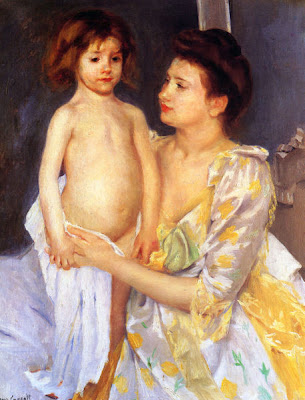
In Jules Being Dried by His Mother (above, from 1900), Cassatt depicts the next stage of the process. Degas loved to show women after the bath, especially during that awkward transition from water to dry ground. Little Jules here looks straight ahead while his mother’s eyes lock on his face with affection. In this painting, the intimacy seems almost one-sided. Cassatt paints their disconnect rather than a connection here. Little Jules is not so little anymore. He seems ready to do things for himself. Jules’ expression shows almost a kingly tolerance of his mother drying his limbs. The elaborate dress of Jules’ mother appears almost courtly rather than realistic, adding to the regal indifference of princely Jules. (I personally prefer a t-shirt and running shorts when administering ablutions.) Stylistically, Cassatt begins to turn more Impressionist. Jules Being Dried by His Mother shows an almost Renoir-like softness in the modeling of faces and bodies, an interesting divergence from the influence of Degas. Although unrealistic, the pattern of yellow and white as well as the shimmering highlights of the mother’s dress make it the star of the painting.


In After the Bath (above, from 1901), Cassatt copies the gestural pastel technique of Degas in the parallel lines that make the picture almost seem to move. Degas allowed himself to grow bolder and bolder in this technique to the point that the bathers or dancers in the work became almost superfluous to the technique. Cassatt, however, continues to center the image on the relationships of the subjects. In After the Bath, Cassatt returns to the intimacy of mother and child, but with the added twist of a love triangle formed by the presence of an older sibling. Sigmund Freud and his idea of sibling rivalry developing from the Oedipus complex were not yet mainstream ideas, but any student of human nature such as Cassatt instinctively knew that siblings will fight among themselves for more face time with parents. Is the older child’s grip on the baby’s wrist a gesture of affection of an attempt to break the contact between baby and mother? The painting doesn’t offer any clues as to motivations or final outcome but does allow for the possibility of connection or conflict. As a woman, Cassatt felt limited in her range of subjects. Painting in the acceptable genre of bath time, Cassatt could subversively explore avenues in the human heart that exist at every age.

Thursday, April 16, 2009

A Man of His Time


Any statement by any artist is always to some degree a document of that time and place. It’s an unavoidable truth. Either by consciously fighting against or unconsciously following along with the status quo, artists always act in response to the here and now. Many critics today look at Thomas EakinsThe Dancing Lesson (above, from 1878) and see a sympathetic rendering of three generations of African-Americans sharing the music and dance of their culture. In Thomas Eakins and the Cultures of Modernity, however, Alan C. Braddock sees something different going on. He argues that the definition of “culture” that modern critics read into The Dancing Lesson, which was originally called simply The Negroes, is one Eakins would never have known. “The art of Eakins embodies a premodern understanding of cultural difference,” Braddock argues. Eakins and the late nineteenth century would have seen African-American culture as a “lesser” kind or a preliminary step in the evolutionary ladder leading up to Western European culture, the pinnacle of civilization, at least to Western Europeans and their descendents. Eakins places in the upper left corner of The Dancing Lesson a photo of Abraham Lincoln reading with his son Tad, thus illustrating the gap between African-American tradition and white Anglo-American tradition. Only in the 1920s and 1930s did anthropologists see culture as a social construct rather than a racial one. In Thomas Eakins and the Cultures of Modernity, Braddock steps back in time and puts himself in Eakins nineteenth century shoes to better understand the American mind on the cusp of a new concept of culture.


Braddock excels in making familiar images from Eakins’ oeuvre come to fresh life with new implications. He begins by tracing Eakins’ conflict with culture back to his time training in Paris with Jean-Leon Gerome from 1866 through 1870 and his time in Spain on the suggestion of his other teacher Leon Bonnat. Yet another teacher, Hippolyte Taine, put into words the cultural theories that Eakins worked under. Taine “asserted the importance of viewing works of human creativity as the natural, objective residue of national character,” Braddock writes. In Paris during the 1867 Exposition Universelle, Eakins experienced a world of difference as representatives (and misrepresentatives) of different nations and races gathered together in what Braddock calls “a monumental spectacle of nomadic strangeness.” That world fair placed people on display for the first time, providing “living evidence of evolutionary difference,” Braddock explains, for Eakins and his contemporaries. Gerome, Eakins’ primary teacher, excelled in exotic Orientalism that never progressed beyond picturesque slumming. Eakins echoes Gerome’s view of Western civilization’s primacy throughout his career, even as late as 1885 with Swimming (above). Setting Swimming in an idyllic, but still identifiable location outside Philadelphia, Eakins both evokes the ancient Greeks and escapes from the contemporary ethnic masses then filling the city. Braddock sees this “aesthetic vision of suburban retreat to a contemporary, local Arcadia” as a precursor to the modern phenomenon of “white flight” now decimating major American cities.


As a life-long Philadelphian, I find it hard to believe that the waters of the Schuylkill River once were even more polluted in the nineteenth century, leading to a public health hazard that claimed many lives, including that of Eakins’ own sister Margaret. Yet, when Eakins painted The Champion Single Sculls (Max Schmitt in a Single Scull) (above, from 1871), we see not the green ooze of contemporary descriptions Braddock provides but a blue oasis. Braddock bashes the familiar trope of Eakins as the ruthlessly exacting realist, showing how “none of the gritty frankness about modern environmental realities” enters the pictures. Eakins specifically plays with the facts to “sell” the “commodity” of “local color,” which for Philadelphia meant outdoor activities such as rowing. This local color makes up much of the culture of Eakins time and place, but that local color owes much to the internationalism of Eakins’ art education. “Viewing Eakins and his art simply in terms of Philadelphia ‘roots’ or American national character also misses the cosmopolitanism of ‘local color’ itself as a widely circulating commodity in which he and many contemporaries traded,” Braddock writes. Eakins painted a very ordered world in which heroic whites such as Max Schmitt rowed the “beautiful” waters of the Schuylkill while black guides led middle-class hunters through the marshes in paintings such as Pushing for Rail. “Eakins’s realism differentiated the various people and aquatic zones around Philadelphia according to a picturesque logic that embodied middle-class expectations and assumptions,” Braddock argues. Even when the harsh reality of life in Philadelphia claimed one of his family, Eakins refused to disrupt his view of the neatly ordered pyramid of cultural progression.


Eakins’ scandalous dismissal from teaching at the Pennsylvania Academy of the Fine Arts in 1886 put that ordered world into jeopardy. Following the popular trend begun by Theodore Roosevelt, Eakins looked west, and traveled to the Badlands. For Eakins and others, the American West becomes “a powerful metaphor of national renewal, progress, and civilization at a pivotal moment of modernization,” Braddock explains. Taking in the ideas behind TR’s glorification of the victory of white settlers over Native Americans as well as the racial subtext of Buffalo Bill’s Wild West show, Eakins idolized the American cowboy as the epitome of American cultural superiority overcoming their lesser, i.e., the Native Americans. As Braddock points out, Eakins’s Cowboys in the Badlands (above, from 1888) clearly echoes Gerome’s Bonaparte Before the Sphinx, which shows the conquering Napoleon looking down upon ancient Egyptian culture. The template of cultural evolution inherent in Gerome’s work finds its way again and again into that of his greatest student.


For all the study of Eakins’ relationship with physicians, most famously in his masterpiece The Gross Clinic, less attention has been paid to the artists’ relationship with several of the anthropologists that helped found The University of Pennsylvania Museum of Science and Art (now known as The University of Pennsylvania Museum of Archeology and Anthropology) in 1889. Eakins painted portraits of seven people heavily involved in the growing field of anthropology at the turn of the century. “Standing chronologically on the threshold of the modern culture concept but never really encountering or comprehending it,” Braddock writes, “Eakins and his art marked the twilight of nineteenth-century anthropological thought. The portraits [of these anthropologists] serve s the visual epitaphs to an obsolescent paradigm.” The most fitting painted epitaph of this paradigmatic twilight may be Eakins portrait of Frank Hamilton Cushing (above, from 1895). Cushing studied the culture of Zuni Native Americans in New Mexico, adopted their dress, and even learned some of their rituals. Eakins shows Cushing engaged in incantations in full ceremonial dress. Braddock recounts meetings with present-day Zuni Indians who recoil from the portrait and how it disrespects their sacred customs. That sense of of the portrait’s insensitivity serves as a handy barometer for just how different the concept of culture between Eakins’ time and ours.

Braddock provides excellent insights into Eakins’ place in nineteenth century art as the world began to grow smaller and cultural interactions became increasingly unavoidable. He shows the biases and, to modern audiences, racism of Eakins without demonizing him ala Henry Adams in Eakins Revealed. Most criticism of Eakins still lingers in the shadow of Lloyd Goodrich’s adoption of Eakins as the quintessential American artist in the 1920s, much as literary critics rediscovered Herman Melville as the quintessential American novelist in that period’s manic race to generate a legacy of American culture long after the fact. Thomas Eakins and the Cultures of Modernity strips away the easy generalities of Eakins the ruthless realist and Eakins the cultural outsider to recover the flesh and blood Eakins of his time and place, for good and ill, in all his wonderfully flawed humanity.

[Many thanks to the University of California Press for providing me with a review copy of Alan C. Braddock’s Thomas Eakins and the Cultures of Modernity.]

Tuesday, February 3, 2009

Imported Goods


I’ve always found it fascinating how the first quintessentially “American” school of thought—Transcendentalism—borrowed heavily from non-American sources. Ralph Waldo Emerson, Henry David Thoreau, and others drew heavily from Eastern mysticism, Immanuel Kant and German Idealism, and Emanuel Swedenborg. Of course, all things quintessentially American came from somewhere else, the “mutt” leader of the world. Even Thomas Cole, the lead member of Transcendentalist-tinged Hudson River School, the first American art movement, came from England. Born February 1, 1801 in Lancashire, England, Cole was 17 years old when he first came to America, moving about with his family until finally formally learning painting at the PAFA in 1825. Soon after, Cole set out on his career of painting spiritually moving landscapes of American scenes of New England and the Catskill Mountains of New York. Yet, Cole resists the label of a purely “American” painter. Cole always painted some version of paradise, sometimes literally as in The Garden of Eden (above, from 1828). Regardless of location, the perfect landscape always existed in a timeless, locationless place in his imagination.


Cole spent several years in the early 1830s and early 1840s living in England and Italy. In Landscape and Memory, Simon Schama argues that landscape painters are shaped in part by the landscape before them. In other words, the local growth of the American scene provides different materials than the forests of England or Europe, which then influence the work of the artist. Cole saw enough of these different landscapes that they eventually mingled into the “idea” of a landscape over time. A good Transcendentalist, Cole transcended the mundane facts of the landscape and struck at the spirit of the woods. Cole’s L'Allegro (Italian Sunset) (above, from 1845) borrows a title from the British poet John Milton and sets itself in Italy, but the idealized light and pastoral sensibility come entirely from the amalgamation in Cole’s head and heart. The liveliness of the upbeat figures in the foreground contrasts sharply with the deathly stillness of the classical ruins far in the distance. Cole painted series such as The Course of Empire and The Voyage of Life as overt allegories, but for him every landscape was an allegory.


Cole also painted Milton’s pendant poem to L’Allegro, Il Penseroso (above, from 1845). The prone, pensive figure before the religious ruin in the foreground resembles one of the figures seen dancing in L’Allegro. Like Milton, Cole wants to offer both sides of the human emotional coin. The ancient-looking icon is pure Old World, but the abundance of greenery speaks more of the still-virginal American forests of Cole’s day. Cole perfectly combines the wisdom of the ages of Western Civilization with the fresh perspective of the rising American experiment. Again, this combination is, paradoxically, exactly what makes it so “American” in nature. Cole’s Europeanism resembles Milton’s classicism in that both take the lessons of yesterday to construct new meanings for their own age, and ours. Never a slave to realism, Cole painted more realistic landscapes by delving into his soul and the souls of other thinkers and artists and assembling a landscape more of meaning and memory than just trees and grass.

Tuesday, December 2, 2008

The Original Maverick

Peter Saul, Self, 1987; Acrylic and oil on canvas, 72 x 100 inches (182.9 x 254 cm); Private collection, New York; courtesy George Adams Gallery, New York.

In the 1953 film The Wild One, someone asks Marlon Brando’s character, a rough motorcycle gang leader, “What are you rebelling against?” Brando snarls back, “Whattya got?” Similarly, Peter Saul never met a idea he couldn’t rebel against in his art. In a retrospective exhibition currently at the Pennsylvania Academy of the Fine Arts, the motivations of this original maverick are examined. “Considering how much American art over the past two decades has been devoted to dissecting the dark underbelly of the beached American dream,” writes Dan Cameron in his essay “Front Row Seats in Hell” in the exhibition catalogue, “one might even be excused for thinking that Saul is one of the quintessential U.S. painters of the past 50 years, as egregiously underrated as he is pathologically incorrigible.” Saul’s incorrigibility blankets over his ability as both an artist and a social commentator. In a work such as Self (above, from 1987), Saul cracks open his own cranium to reveal the conflicting forces within. “Expression (a firecracker) and Abuse (a lit cigarette) seem to be in a perpetual standoff with Knowledge (a soup spoon) and Esteem (a condom nailed to a cross),” Cameron writes of Self. Fearful of falling into what Saul calls “that giant pit of so-called truth, good intentions, and responsible attitude,” the artist maintains a uneasy alliance with his own head while picking through modern systems of belief and refusing to buy into any of them.


Peter Saul, Icebox Number 7, 1963; Oil on canvas, 74 1/2 x 63 inches (188 x 160 cm); Collection of Mr. and Mrs. Bill Lenox, Dallas.

The first modern system of belief Saul strikes out at is consumerism in works such as Icebox Number 7 (above). The Icebox series offers “compendiums of aggressive consumer madness,” writes Michael Duncan in “The Spectacular Wrath of Saul: Peter Saul’s History Paintings.” Duncan places Saul within the larger tradition of history painting kicking and screaming, just the way Saul would prefer. Saul paints the Icebox series just after returning to America after living in Holland and Paris. As Cameron points out, Saul not only leaves Europe itself behind but also European style itself. Upon Saul’s return, he adopts “a more slickly hard-edged, hyper-American technique” that “successfully fused the distorted angst of Francis Bacon with the aerodynamic sleekness of H.C. Westermann.” Once Saul set his sights on America as his main subject, the possibilities seemed endless, especially since he attacks every side of every issue. Although Saul is personally more liberal than conservative, Cameron believes, “what appears to motivate Saul more than rage is indignation over the hypocrisy of American liberals.” For Saul, liberals can never be liberal enough as they always cling to some ideology. Saul seeks and ideology-free zone, which may be impossible but remains the only climate his conscience can survive in.

Peter Saul, Columbus Discovers America, 1992-95; Acrylic and oil on canvas 96 x 120 inches (243.8 x 304.8 cm); Levy Family Collection, Dallas.

When it came to history painting, Saul first thought locally, then globally. Living in California in the 1960s, during the draconian governorship of Ronald Reagan, Saul depicted Reagan and his policies with “scatological vehemence” in works such as Government of California, according to Cameron. Saul also protested the Vietnam War, while simultaneously depicting the war crimes of American soldiers. “There are no heroes in his paintings, no victories, no coronations, no causes for inspiration or spiritual uplift,” Duncan writes of Saul’s unique brand of history painting. Some of Saul’s take on modern society’s accepted level of madness comes from the sensibility and visual style of Mad Magazine, especially the art of Basil Wolverton. The relentless irreverence of Mad Magazine, aimed at an “immature” audience, informs Saul’s work in that he refuses to grow up if that means growing comfortable with injustice in any form, especially passive acceptance. “I feel completely relaxed in rebellion,” Saul tells Robert Storr in the extended interview in the catalogue. In works such as Columbus Discovers America (above), Saul “has developed a style dedicated to the dystopian reversal of all ideals—a comic-book grand manner,” Duncan believes. For those growing up on the rebellion of comic books and their “ugly” style, Saul’s work reveals a whole new way of seeing the world as an adult through the eyes of a perpetually angry young man.

Peter Saul, Cold Sweat, 1999; Acrylic on canvas, 55 ¼ x 66 3/4 inches (140.3 x 169.5 cm); Private collection, New York; courtesy David Nolan Gallery, New York.

Saul, of course, is no longer a young man. Cold Sweat (above) shows an aging figure coming to terms with the limits of his physicality. As Cameron points out, Cold Sweat presents “the eruption of the body’s interior fluids as a problem in social etiquette for those who are viewing from the outside, while discounting the genuine agony of the poor aging slob who cannot control the workings of his own body.” Similarly, Saul’s work remains uncomfortable for everyone, including himself in terms of a failure to achieve much recognition in the art world. “The professional art world seemed to me like working in an office building,” Saul says of his early days and his choice to buck the system. Works such as Double de Kooning Ducks and Donald Duck on Toilet Descending a Soft Watch spoof, respectively, Willem de Kooning, Walt Disney, Marcel Duchamp, and Salvador Dali, just a few of the art history targets Saul set his sights on. Saul never asks for acceptance by the art world, knowing that none would be coming and not really wanting it if it did. By adopting a brightly colored, cartoonish style, Saul circumvents all art world apparatus and speaks directly to the viewer, which, as Cameron writes, “is another way of saying to the critical establishment that while [Saul] may care about its judgments, he will always behave as if he has risen above them.” Saul prefers to sweat out the judgment of history, bathing in the knowledge that he remained true to himself throughout.

Peter Saul, Bush at Abu Ghraib, 2006; Acrylic on canvas 78 x 90 inches (198.1 x 228.6 cm); Hall Collection.
“There’s a tremendous need to be not seen as a racist, not seen as a sexist,” Saul tells Storr. “So I want to make sure I am seen as those things.” Even in his seventies, Saul still steps on toes. Bush at Abu Ghraib (above), reminds us “that nothing that can be summoned from the dregs of the individual creative imagination is anywhere near as terrible as the actual horrors taking place right now, in our name, somewhere on the opposite side of the planet.” Saul paints “ugly,” but in the “ugly” tradition of Goya, William Hogarth, William Blake, and others who step outside of the parameters of acceptance to reject a world. Dan Cameron, Michael Duncan, and Robert Storr’s Peter Saul and the accompanying exhibition introduce us to an artist who has been under our noses all along, saying all the things we should have been saying, and quietly waiting for a moment of understanding if not acceptance on his own terms and not those of the art world or society at large. This catalogue and exhibition are as much a blessing and a gift upon us as they are upon Saul, the real original maverick.

[Many thanks to the Pennsylvania Academy of the Fine Arts for providing me with a review copy of Dan Cameron, Michael Duncan, and Robert Storr’s Peter Saul and for the images above from the exhibition.]

Wednesday, October 15, 2008

Putting on a Show


When American artist John Vanderlyn traveled to study art in France in 1796, thanks to the patronage of Aaron Burr, he came back five years later with a style of draftsmanship that few other American artists could match. Born October 15, 1775, Vanderlyn brought back French draftsmanship and, more importantly, the French appreciation for the bravura nude back with him. Vanderlyn’s Ariadne in Naxos (above, from 1808-1812) shocked American audiences at the time, even with the convention of casting the figure as a classical nude rather than a living, breathing, contemporary nude. When you see Vanderlyn’s pin-up girl today at the PAFA sticking out like a sore thumb amongst its contemporaries and their more family-oriented subject matter, you get a sense of just how shocking Ariadne must have been. To a young country with a strong Puritan sensibility, a barely formed art tradition of its own, and little exposure to the art tradition of European history (the great American museums and their European collections were almost century away), Vanderlyn’s nude seemed alien and, literally, foreign. To his credit, Vanderlyn rolled the dice, risked his still growing career as a portraitist, and won.


Unfortunately, Vanderlyn soon aimed more at his audience’s tastes rather than at edifying works of art. The Death of Jane McCrea (above, from 1804) shows painterly propaganda at its worst. Vanderlyn paints here the story of Jane McCrea, a young American woman allegedly murdered in 1777 by Iroquois working for the British during the American Revolutionary War. Vanderlyn shows the cruel tribesmen at the fateful moment when they claim the scalp of the long-haired maiden. Playing to anti-Native American feelings, lingering resentment against the British, and ancient chivalric codes all at once, Vanderlyn struck a chord with his contemporary American audience, giving them exactly what they wanted to fit in with their prejudices. (Ms. McCrea’s exposed cleavage no doubt titillated male audiences, too.) Colonial rebel organizers used the story of Jane McCrea to rouse citizens into fighting the British more fervently during the Revolution. Vanderlyn no doubt knew that history and hoped to capitalize on repeating it for a new generation.


For most of the rest of his career, Vanderlyn painted huge panoramic works that he showed to the public for a charge. His Panoramic View of the Palace and Gardens of Versailles (above, from 1818–1819) was the iMAX theater of its day, providing thrills to Americans who only knew of Europe’s great palaces and cities from descriptions in books. Aside from those show pieces (which turned a poor profit for the slow-working artist), Vanderlyn continued to cultivate connections within the United States government, carefully leaving his ties to the disgraced Aaron Burr in the past. Presidents James Monroe, Andrew Jackson, and Zachary Taylor all sat for portraits by Vanderlyn. In 1842, thanks to high-placed connections, Vanderlyn received a commission from the U.S. Congress to paint a scene of Christopher Columbus’ discovery of the new world. Pressed for time and plagued by declining skills, Vanderlyn outsourced the job to another artist. Although the Native Americans cowering at Columbus’ feet in the finished work in the U.S. Capitol Rotunda could belong to Vanderlyn, they most likely don’t. A decade later, Vanderlyn died in obscurity, far from the crowds he longed to attract.