Showing posts with label Psychology and Art. Show all posts

Friday, March 11, 2011

Even a Monkey: Telling Good Abstract Art from Bad


“I could paint that!” Or, “Even a monkey could paint that!” Walk through any museum or gallery containing modern abstract art and you’ll most likely hear similar sentiments from those who think little of abstract art and those who make it. There’s no difference between the paintings selling for thousands and sometimes millions and the finger painting of children in kindergarten, or so the argument goes. A recent study published by two psychologists argues against that idea by showing statistically that people can tell when an abstract painting is done by an adult human. Their experiment asked people with no, little, or much art knowledge to distinguish works by an adult human painter found in an art history book from artwork by a human child, a gorilla, a chimpanzee, an elephant, and, yes, even a monkey. Please come over to Picture This at Big Think to read more of "Even a Monkey."

[Image: Cy Twombly. Untitled (Scenes from an Ideal Marriage), 1986. Oilstick; oil and water color on paper 52 x 72 cm. (20.5 x 28 in.). © Cy Twombly.]

Sunday, September 5, 2010

The Mind’s Eye: Freud and Photography


When we think of Sigmund Freud, we think first of words—the “talking cure” of psychoanalysis, books such as The Interpretation of Dreams, and the infamous Freudian slip. In Mirrors of Memory: Freud, Photography, and the History of Art, Mary Bergstein, Professor in the History of Art and Visual Culture at the Rhode Island School of Design, suggests we should instead think of pictures, specifically photography. “[P]hotography penetrated the cognitive style of Freud and his contemporaries,” Bergstein asserts in decidedly Freudian language, and “documentary photography—of art and archaeology, but also of medicine, science, and ethnography—influenced the formation of Freudian psychoanalysis.” Photography, with its fragmentary and evocative elements, mirrors the way human memory works for Freud. Thus, the mind’s eye, both conscious and subconscious, mimics the photographic lens. Mirrors of Memory provides a new lens through which to view Freud’s development within the early development of photography and the visual culture we now live in. Please come over to Picture This at Big Think to read more of "The Mind's Eye."


[Many thanks to Cornell University Press for providing me with a review copy of Mary Bergstein’s Mirrors of Memory: Freud, Photography, and the History of Art.]

Thursday, June 11, 2009

Correspondence Course


One of the reasons that modern art has left much of the public behind is the sheer weight of the theorizing that has gone into so many movements. The importance of a blank canvas buttressed by a manifesto leaves even some interested parties bewildered. What, then, should we make of the theory-less theorist—William Baziotes. Born June 11, 1912, Baziotes painted in a Surrealist style and frequented Abstract Expressionist circles with Mark Rothko and Robert Motherwell, but he resisted easy categorization. In 1947 he confessed his theoretical agnosticism in an essay titled, “I Can’t Evolve Any Concrete Theory,” a shocking admission in an age when Clement Greenberg and others wrung theoretical juice from everything at hand. Baziotes takes his cue from French Symbolist poets such as Charles Baudelaire. Yet, unlike other artists, such as Gustav Klimt or Edvard Munch, Baziotes leaves easily recognizable forms such as the human body behind. Instead, Baziotes subscribes to Baudelaire’s idea of “correspondences” in which all natural things are equal to the point that anything can symbolize a vast number of things. Baudelaire writes in the poem “Correspondences,” “Like prolonged echoes mingling in the distance/ In a deep and tenebrous unity, / Vast as the dark of night and as the light of day, / Perfumes, sounds, and colors correspond.” Baziotes translates Baudelaire’s mystic ideas into paint in works such as The Flesh Eaters (above, from 1952), in which biomorphic forms that look natural but resist identification interact to generate a narrative built by each viewer from the depths of their own imagination. The Flesh Eaters of the title can be cannibals, Polyphemus the cyclops eating Odysseus’ crew, or a larger metaphor for humanity’s self-consuming desires run amok. The possibilities, like nature, are endless.


Baziotes worked extremely slowly, completing only one or two works during his prime years in the 1950s. While Jackson Pollock stepped on the gas and dripped his way to fame and infamy, Baziotes applied the brakes, quietly mediating over his works before allowing himself to begin the act of painting itself. "I want my pictures to take effect very slowly,” Baziotes claimed, “to obsess and haunt." Baziotes’ Dusk (above, from 1958) haunts through its elusiveness. The dusky pink shape and trailing ribbons of green, blue, and white are all that interrupt the pensive grey background. While teaching and painting in New York City, Baziotes frequented the Greek sculpture and pottery collections. Of Greek descent himself, Baziotes may have identified with the classical forms on multiple levels. The lines in Dusk resemble on one level the cracks in ancient vases they wear like the proud scars of millennia. Longing to replicate the eternalness of nature itself, Baziotes evokes the next best thing in terms of human creativity—the oldest and most lasting forms remaining. In many ways, Baziotes’ Dusk is his version of Keats’ Ode on a Grecian Urn. Both conclude that "’Beauty is truth, truth beauty,’ —that is all/ Ye know on earth, and all ye need to know."


As with the work of Robert Motherwell, I see a lot of Zen in Baziotes’ painting. In the same vein, I also sense a lot of Jung in Baziotes’ approach. In works such as Aquatic (above, from 1961), Baziotes looks to tap into what Jung called “the collective unconscious.” Again, the forms look like something we’ve seen in reality but Baziotes’ skews them just enough to make them seem dreamlike. In Aquatic, Baziotes becomes an artist of the floating world, riding the currents of his unconscious with the faith that his audience will meet him on the same high seas. As with the connection to ancient sculpture in Dusk, Aquatic connects back to the primordial sea, the source of all life on Earth. Baziotes titled this work to make the sea link clear, but I think the imagery itself would eventually lead most onlookers to that watery source. I began with the idea that Baziotes was theory-free and then proceeded to drop the names of Baudelaire and Jung to impose theory on him once again, whether Baziotes wanted to or not. Strip away all these ideas and even the titles of the works, however, and you still find yourself drawn to them as if called by something instinctual. It’s unfortunate that Baziotes’ art is often swamped by the bigger names of American art in the 1950s, but the intentional timelessness of his works gives them a “patience” that still may one day be rewarded.

Monday, May 25, 2009

Rub a Dub Dub


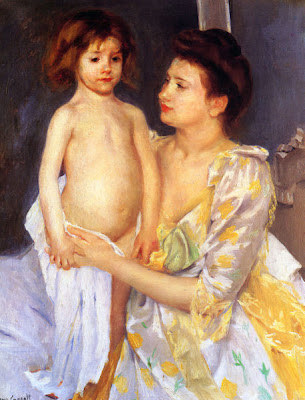
Any parent will tell you that one of the most “interesting” parts of their day is bath time. Thanks to a small armada of toy boats, Mr. Bubble, and assorted other tricks, Alex usually enjoys his bath time. After pulling my slippery three year old from the suds and wrapping him up in a dry towel, I sweep him up in my arms and hold him close to keep him warm. For that brief moment, he’s our little baby again. Although never a parent herself, Mary Cassatt painted many scenes of mothers and children during bath time. Born May 22, 1844, Cassatt met Edgar Degas and worked closely with him. Degas’ interest in the female nude in a bath setting may have spurred Cassatt’s interest in her own bath pictures, which have a more acceptably “female” approach in the motherly relationship between child and parent. Cassatt’s The Bath (above, from 1891-1892) shows the early style of Cassatt, not yet fully Impressionist yet no longer entirely the strict realism of her PAFA training. Around the time of this painting, Cassatt saw an exhibition of Japanese prints as part of the larger Japonisme fad of the age. Elements of Japonisme appear in The Bath in the diagonal of the child’s body crossing against the near diagonals of the mother’s striped dress. The flatness of much of the color also shows the influence of Japanese prints. In addition to all these styles straining against each other simultaneously, Cassatt tenderly depicts the intimacy of the mother and child at the moment that the child is the most vulnerable.


In Jules Being Dried by His Mother (above, from 1900), Cassatt depicts the next stage of the process. Degas loved to show women after the bath, especially during that awkward transition from water to dry ground. Little Jules here looks straight ahead while his mother’s eyes lock on his face with affection. In this painting, the intimacy seems almost one-sided. Cassatt paints their disconnect rather than a connection here. Little Jules is not so little anymore. He seems ready to do things for himself. Jules’ expression shows almost a kingly tolerance of his mother drying his limbs. The elaborate dress of Jules’ mother appears almost courtly rather than realistic, adding to the regal indifference of princely Jules. (I personally prefer a t-shirt and running shorts when administering ablutions.) Stylistically, Cassatt begins to turn more Impressionist. Jules Being Dried by His Mother shows an almost Renoir-like softness in the modeling of faces and bodies, an interesting divergence from the influence of Degas. Although unrealistic, the pattern of yellow and white as well as the shimmering highlights of the mother’s dress make it the star of the painting.


In After the Bath (above, from 1901), Cassatt copies the gestural pastel technique of Degas in the parallel lines that make the picture almost seem to move. Degas allowed himself to grow bolder and bolder in this technique to the point that the bathers or dancers in the work became almost superfluous to the technique. Cassatt, however, continues to center the image on the relationships of the subjects. In After the Bath, Cassatt returns to the intimacy of mother and child, but with the added twist of a love triangle formed by the presence of an older sibling. Sigmund Freud and his idea of sibling rivalry developing from the Oedipus complex were not yet mainstream ideas, but any student of human nature such as Cassatt instinctively knew that siblings will fight among themselves for more face time with parents. Is the older child’s grip on the baby’s wrist a gesture of affection of an attempt to break the contact between baby and mother? The painting doesn’t offer any clues as to motivations or final outcome but does allow for the possibility of connection or conflict. As a woman, Cassatt felt limited in her range of subjects. Painting in the acceptable genre of bath time, Cassatt could subversively explore avenues in the human heart that exist at every age.

Thursday, May 14, 2009

Maneaters


The idea of the “maneater” or, as the French would say, femme fatale is one of the oldest tropes in Western civilization, going all the way back to Samson’s Delilah in the Bible and further back into the darkness before recorded time. Much of the look of the modern maneater comes from the brush of the most sensual member of the Pre-Raphaelite Brotherhood, Dante Gabriel Rossetti. Born May 12, 1828, Rossetti founded the PRB with John Everett Millais and William Holman Hunt and followed the religious and moralizing trend of the Brotherhood at the beginning. However, Rossetti drifted more and more to the carnal over the spiritual, especially after the death of his one-time model, fellow-artist, wife, and everlasting muse Elizabeth Siddal. A year after Lizzie’s death, Rossetti began painting Beata Beatrix (above, from 1864-1870), which casts his departed wife as Beatrice Portinari from Dante Alighieri's poem La Vita Nuova. Dante Alighieri held Beatrice up as the epitome of purity, and Dante Gabriel Rossetti seems to follow suit, but there are hints that Siddal as Beatrice isn’t as snow white. The dove that brings flowers isn’t the conventional white of purity but rather the red of passion. Rossetti ostensibly shows the moment when Beatrice dies and experiences the rapture of the divine embrace, but like Bernini’s Ecstasy of Saint Theresa, the difference between an expression of religious thrill and that of sexual orgasm is clearly blurred. As discussed in Jay A. Clarke’s Becoming Edvard Munch: Influence, Anxiety, and Myth (my review here), Edvard Munch recognized this dual nature in Rossetti’s Beata Beatrix and translated it into his Madonna. Rossetti’s Beata Beatrix perfectly embodies the In Freudian idea of the Madonna-whore complex decades before Freud himself coined the term.


After the death of Lizzie Siddal, Rossetti struggled to find firm footing in her personal life, even as his artistic career blossomed. Rossetti careened among a traffic jam of mistresses, experiencing his fair share of total wrecks. One of those mistresses, Fanny Cornforth, served as the model for Lady Lilith (above, from 1868). Mythology paints Lilith as a strong, usually destructive female force and sometimes even as the first wife of the first man, Adam. Rather than mythologize the scene, Rossetti paints his Lilith in contemporary clothing. Fanny’s Lilith lounges in her bedclothes rather than the corseted garb of Victorian days and contemplates her pouty lips in a mirror. Fast forward a century, and Lady Lilith becomes Sharon Stone crossing her legs in Basic Instinct. Rosetti accompanied Lady Lilith with Sonnet LXXVIII, entitled "Body's Beauty," from his book of poetry The House of Life:

Of Adam's first wife, Lilith, it is told
(The witch he loved before the gift of Eve,)
That, ere the snake's, her sweet tongue could deceive,
And her enchanted hair was the first gold.

And still she sits, young while the earth is old,
And, subtly of herself contemplative,
Draws men to watch the bright web she can weave,
Till heart and body and life are in its hold.
The rose and poppy are her flowers; for where
Is he not found, O Lilith, whom shed scent
And soft-shed kisses and soft sleep shall snare?
Lo! as that youth's eyes burned at thine, so went
Thy spell through him, and left his straight neck bent
And round his heart one strangling golden hair.

The long hair Lilith dithers with in the painting becomes literally a noose that strangles unfortunate men in the poem. Whereas Beata Beatrix was equal parts Madonna and whore, Lady Lilith is pure harlot of the black widow variety.


It’s easy to see Rossetti as an embittered chauvinist in his portrayals of his maneaters. Just as the dangerous Lilith is also the strong woman of Lilith Fair fame, Rossetti’s femme fatales are also copies in some respect of the highly accomplished Lizzie Siddal, the supermodel of Pre-Raphaelitism that added a sister to the Brotherhood. With Venus Verticordia (above, from 1863-1868), Rossetti maintains the sense of danger while simultaneously exposing the full power of womanhood. As with Lady Lilith, Rossetti appended a sonnet to Venus Verticordia:

She hath the apple in her hand for thee,

Yet almost in her heart would hold it back;

She muses, with her eyes upon the track

Of that which in thy spirit they can see.

Haply, 'Behold, he is at peace,' saith she;'

Alas! the apple for his lips, - the dart

That follows its brief sweetness to his heart,

-The wandering of his feet perpetually.'

A little space her glance is still and coy;

But if she gets the fruit that works her spell,

Those eyes shall flame as for her Phrygian boy.

Then shall her bird's strained throat woe foretell,

And as far seas moan as a single shell,

And her grove glow with love-lit fires of Troy.

Rossetti mixes the message of menace found in the poem by adding natural touches to the painting. The arrow and apple of doom remain in the painting, but the lack of clothes (hence, all trappings of civilization) and addition of flowers portray Venus as Mother Nature, and you don’t fool with Mother Nature. Rossetti painted the face of Venus from one of his model-mistresses, Alexa Wilding, but he painted the body from a tall nanny that he happened to pass in the street. Only a woman who literally stood head and shoulders above the crowd would fit the bill for this painting. Rossetti painted all three of these maneaters around the same time, showing how he moved back and forth in his view of the subject—a complex and complexing concept that consumed him as he created the most unforgettable images and poems of his career.