Showing posts with label Gauguin (Paul). Show all posts

Sunday, April 3, 2011

Reorientation: The Orient Expressed at the Mississippi Museum of Art


“Disorientation is lost of the East,” novelist Salman Rushdie has written, reminding us of the original meaning of “Orient.” In The Orient Expressed: Japan’s Influence on Western Art, 1854-1918, which runs at the Mississippi Museum of Art through July 17, 2011, the curators hope to reorient us to the term Japonsime so that we can find the East, or more accurately the East of the 19th century West, lost over time. The sense of wonder over the new world of Japan suddenly opened up in 1854 is something we today could only experience if life were found on Mars. In the catalog and exhibition itself, Japan, currently reeling from disaster, reemerges as the rich land of culture and style so influential on Western art and design. It’s a reorientation course we in the West can’t do without. Please come over to Picture This at Big Think to read more of "Reorientation."

[Image: Paul Gauguin (French, 1848–1903), Still Life with Onions, Beetroots and a Japanese Print, 1889. oil on canvas. 16 x 20.5 in. Collection of Judy and Michael Steinhardt, New York, New York.]

[Many thanks to the Mississippi Museum of Art for providing me with the image above and press materials for the exhibition The Orient Expressed: Japan’s Influence on Western Art, 1854-1918, which runs through July 17, 2011. Many thanks also to the University of Washington Press for providing me with a review copy of the catalog to the exhibition.]

Thursday, February 17, 2011

Failing Chemistry: When a Good Van Gogh Goes Bad


Around this time of year many high school and college students worldwide come to the sad realization that they’re failing chemistry. To them, a mole will always be just a burrowing mammal. Sometimes Avogadro’s number just has your number. Now, however, those sufferers have distinguished company—Vincent Van Gogh. A team of European scientists have isolated the chemical process that has been turning sunny yellow Van Gogh paintings into somber brown studies over the years. Their findings remind us of how artworks are truly living things, capable of living long after their creator, but also vulnerable to the ravages of time. Please come over to Picture This at Big Think to read more of "Failing Chemistry."

[Image: This illustration shows how X-Rays were used to study why van Gogh paintings lose their shine. Top: a photo of the painting Bank of the River Seine on display at the van Gogh Museum, divided in three and artificially colored to simulate a possible state in 1887 and 2050. Bottom left: microscopic samples from art masterpieces moulded in plexiglass blocks. The tube with yellow chrome paint is from the personal collection of M. Cotte. Bottom right: X-ray microscope set-up at the ESRF with a sample block ready for a scan. Center: an image made using a high-resolution, analytical electron microscope to show affected pigment grains from the van Gogh painting, and how the color at their surface has changed due to reduction of chromium. The scale bar indicates the size of these pigments. Courtesy of ESRF/Antwerp University/Van Gogh Museum.]

Wednesday, January 19, 2011

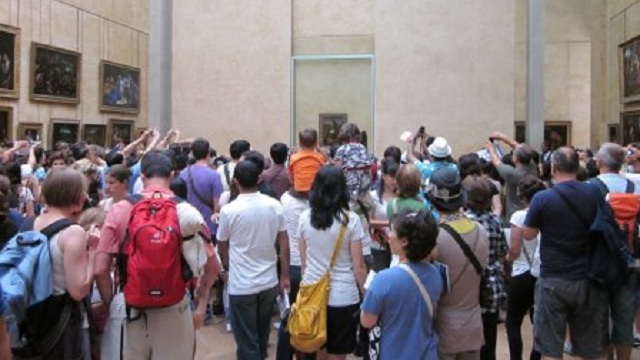
Anger Management: Fighting the Crowds at Blockbuster Art Shows


Great art can sometimes be like a magnet—attracting hordes of admirers. The Gauguin: Maker of Myth exhibition that recently closed at the Tate Modern in London, England, drew more than its fair share of fans. According to some patrons, it was far more than a fair share, as complaints that the crowds took away from their enjoyment of the show mount. Is it fair that some people seem to “hog” the art and deny others the lingering look they desire? Or is such box office success the price to pay to see great art in great quantities brought to your locale? How can the anger such blockbuster shows generate be managed? Please come over to Picture This at Big Think to read more of "Anger Management."

Monday, December 20, 2010

A Legend in His Own Mind: Gauguin’s Myth Making


After spending some tumultuous time together at the infamous “Yellow House” in Arles, Vincent van Gogh, no stranger to psychiatric help, thought that fellow artist and former roommate Paul Gauguin could use a professional, too. Taking Vincent at his word, modern art’s original odd couple thus seem more alike than different in the fragmentation of their personalities. Gauguin: Maker of Myth, the catalog to the exhibition running at the Tate Modern in London, England, through January 16, 2011 before moving on to the National Gallery of Art, Washington, DC, from February 27 through June 5, 2011, picks up the pieces of what seems to be Gauguin’s shattered psyche and reveals the method behind his madness. Both a deliberate and an accidental mythmaker, Gauguin first became a legend in his own mind before he could become a legend in his own time, or ours. Please come over to Picture This at Big Think to read more of "A Legend in His Own Mind."

[Image: Paul Gauguin. Self-Portrait with Yellow Christ, 1889-1890.]


[Many thanks to Princeton University Press for providing me with a review copy of Gauguin: Maker of Myth, the catalog to the exhibition running at the Tate Modern in London, England, through January 16, 2011 before moving on to the National Gallery of Art, Washington, DC, from February 27 through June 5, 2011.]