Showing posts with label Cassatt (Mary). Show all posts

Monday, September 13, 2010

The Ones You Love: The Art of Alice Neel


“I don’t care for bohemian culture. Innocent people are hurt by it,” says Richard Neel, eldest son of the painter Alice Neel in Andrew Neel’s documentary film, now available on DVD from New Video. “I was hurt by it.” “You always hurt the one you love,” goes the old pop standard. In this film, Neel’s grandson Andrew, two sons, friends, and critics gather to sing a bittersweet love song to the woman who painted in obscurity for much of her life only to find renown near the very end. The resulting chorus reflects the disharmony of her personal life and the life she gave her sons (and abandoned daughter), as well as the deep feeling Alice had for each of her portrait subjects. It’s this paradox of unfeeling and feeling that makes Alice Neel the person and the artist, and now the film, so compelling. Please come over to Picture This at Big Think to read more of "The Ones You Love."

[Many thanks to New Video for providing me with a review copy of Alice Neel, now available on DVD.]

Monday, May 25, 2009

Rub a Dub Dub


Any parent will tell you that one of the most “interesting” parts of their day is bath time. Thanks to a small armada of toy boats, Mr. Bubble, and assorted other tricks, Alex usually enjoys his bath time. After pulling my slippery three year old from the suds and wrapping him up in a dry towel, I sweep him up in my arms and hold him close to keep him warm. For that brief moment, he’s our little baby again. Although never a parent herself, Mary Cassatt painted many scenes of mothers and children during bath time. Born May 22, 1844, Cassatt met Edgar Degas and worked closely with him. Degas’ interest in the female nude in a bath setting may have spurred Cassatt’s interest in her own bath pictures, which have a more acceptably “female” approach in the motherly relationship between child and parent. Cassatt’s The Bath (above, from 1891-1892) shows the early style of Cassatt, not yet fully Impressionist yet no longer entirely the strict realism of her PAFA training. Around the time of this painting, Cassatt saw an exhibition of Japanese prints as part of the larger Japonisme fad of the age. Elements of Japonisme appear in The Bath in the diagonal of the child’s body crossing against the near diagonals of the mother’s striped dress. The flatness of much of the color also shows the influence of Japanese prints. In addition to all these styles straining against each other simultaneously, Cassatt tenderly depicts the intimacy of the mother and child at the moment that the child is the most vulnerable.
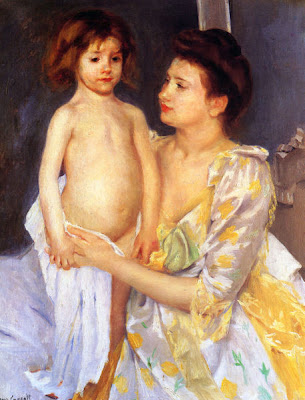


In Jules Being Dried by His Mother (above, from 1900), Cassatt depicts the next stage of the process. Degas loved to show women after the bath, especially during that awkward transition from water to dry ground. Little Jules here looks straight ahead while his mother’s eyes lock on his face with affection. In this painting, the intimacy seems almost one-sided. Cassatt paints their disconnect rather than a connection here. Little Jules is not so little anymore. He seems ready to do things for himself. Jules’ expression shows almost a kingly tolerance of his mother drying his limbs. The elaborate dress of Jules’ mother appears almost courtly rather than realistic, adding to the regal indifference of princely Jules. (I personally prefer a t-shirt and running shorts when administering ablutions.) Stylistically, Cassatt begins to turn more Impressionist. Jules Being Dried by His Mother shows an almost Renoir-like softness in the modeling of faces and bodies, an interesting divergence from the influence of Degas. Although unrealistic, the pattern of yellow and white as well as the shimmering highlights of the mother’s dress make it the star of the painting.


In After the Bath (above, from 1901), Cassatt copies the gestural pastel technique of Degas in the parallel lines that make the picture almost seem to move. Degas allowed himself to grow bolder and bolder in this technique to the point that the bathers or dancers in the work became almost superfluous to the technique. Cassatt, however, continues to center the image on the relationships of the subjects. In After the Bath, Cassatt returns to the intimacy of mother and child, but with the added twist of a love triangle formed by the presence of an older sibling. Sigmund Freud and his idea of sibling rivalry developing from the Oedipus complex were not yet mainstream ideas, but any student of human nature such as Cassatt instinctively knew that siblings will fight among themselves for more face time with parents. Is the older child’s grip on the baby’s wrist a gesture of affection of an attempt to break the contact between baby and mother? The painting doesn’t offer any clues as to motivations or final outcome but does allow for the possibility of connection or conflict. As a woman, Cassatt felt limited in her range of subjects. Painting in the acceptable genre of bath time, Cassatt could subversively explore avenues in the human heart that exist at every age.

Thursday, March 26, 2009

In the Cards


One of the most daunting challenges for anyone wanting to know more about art is deciding where to start. What are the best books to read? Who are the artists you need to know? What paintings should you know first? Masterpiece Cards rides to the rescue of students and art lovers everywhere with their concise collection of 250 cards featuring the greatest paintings from the Renaissance to the 1960s. Masterpiece Cards took forty books on art history and combed their 17,000 pages for the names of paintings from that time span. They collected those names in a database and picked out the 250 works appearing the most often, thus generating a list of greatness as fair as any other. With beautiful quality reproductions and informative text on the rear, each card is a short lesson in art history.


For anyone familiar with art history, these cards will seem like mementos of old friends, such as David’s Oath of the Horatii (above, from 1784). On the reverse, text from one of the references used gives useful insights into the work and its place in the course of art history. A color-coded system at the top indicates where each painting is located, so if you’re headed to France, just grab those marked “France” and let the adventure begin. For students, these make the ultimate “flash cards” of art appreciation class. The information on the back allows you to arrange them in any order you wish—chronologically, nationally, or simply by artist. The text-free fronts will help those using the cards to build up a visual memory of the greats.


Masterpiece Cards has done a great job of avoiding many of the pitfalls of list-making in art. (A full list of the 250 paintings appears here.) Limiting the time frame from the Renaissance to the 1960 means saying no to Giotto, sadly, but also means steering clear of the Damien Hirsts of the contemporary scene, which seems like a fair trade to me. To avoid having a Picasso or Van Gogh take up too much space with their many masterpieces, Masterpiece Cards limited each artist to no more than three masterpieces. Although they’ve culled their choices from long-revered backbreaking tomes such as Janson’s, Arnason’s, and Gombrich’s histories, Masterpiece Cards avoided the trap of sexism, making sure to include obvious (such as Mary Cassatt) as well as not so obvious (the undervalued Helen Frankenthaler) female artists. The choices center almost exclusively on American and European artists, but that reflects the reference books more than any bias on the card-makers’ part, I believe. For better or worse, these cards should work with art history education first and foremost, building the foundation that the student can later tear down as they explore further the art of women, minorities, and non-Western cultures.

Most students today might prefer the easy access of online searches, but, just as e-books can’t replicate the satisfaction of their paper ancestors (at least in my opinion), there’s something satisfying with having these cards in hand. I remember growing up as a kid and having my parents give me the sample Time-Life cards that used to come in the mail to entice you to buy the whole set of cards offering all that is known on the animal kingdom, world history, etc. Ever the inquisitive kid, I used to marvel at those scraps of knowledge, even if the pudu or Council of Trent seemed like lonely facts separated from their laminated brethren. To flip through these cards, handle them, and rearrange them provides the ultimate initial hands-on experience for the young mind soaking in these images and ideas for the first time. As both a educational tool and source of entertainment, Masterpiece Cards are the real deal.

[Many thanks to Masterpiece Cards for providing me with some sample cards for review and for the images above.]