Showing posts with label Titian. Show all posts

Wednesday, June 30, 2010

Double Vision: “Seeing Double” at the Yale Center for British Art


If imitation is the sincerest form of flattery, then John Scarlett Davis must have been the sincerest flatterer in all of England in 1829. In the exhibition Seeing Double: Portraits, Copies and Exhibitions in 1820s London, the Yale Center for British Art solves the “puzzle” of Davis’s painting The Interior of the British Institution Gallery (shown), which caused a stir in the London art scene of 1829 in ostensibly recreating an exhibition of Old Masters hosted in 1829 by the British Institution, a London-based art organization run by collectors and connoisseurs. “Ostensibly” becomes the key word in examining Davis’ painting, as the Yale Center’s research shows just what kind of liberties Davis took in his recreation and to what ends he took those liberties. Please come over to Picture This at Big Think to read more of "Double Vision."


[Image: John Scarlett Davis, The Interior of the British Institution Gallery, 1829. Oil on canvas. Yale Center for British Art, Paul Mellon Collection.]


[Many thanks to the Yale Center for British Art for providing me with press materials for Seeing Double: Portraits, Copies and Exhibitions in 1820s London, which runs through September 19, 2010.]

Friday, June 11, 2010

Foreign Report: A New, Italian Take on Edward Hopper


Leave it to an Italian art publisher to do an American artist right. Skira’s Edward Hopper, distributed in the United States by Rizzoli, may be the finest single volume visually and critically on the elusive yet irresistible 20th century artist. The familiar paintings are all there, but explorations into Hopper’s drawings, his subtle eroticism, his European influences, and even his influence on filmmaking add a whole new dimension, giving us the fullest picture of Hopper possible, all in one of the most beautiful publishing packages imaginable. Please come over to Picture This at Big Think to read more of "Foreign Report."


[Many thanks to Rizzoli USA for providing me with a review copy of Edward Hopper.]

Friday, February 19, 2010

Isn’t It Romantic?: Gauguin’s Nevermore Wins Poll


Quoth the voters, Nevermore! A recent Art Fund poll asking “Which of these people has captured your idea of romance in art?” came up with the answer of Paul Gauguin’s Nevermore (pictured, from 1897). Voters could choose from among five thought-provoking selections picked by a diverse team of experts. It’s more ironic than romantic, and fascinating, that the winner of a Valentine’s Day-themed poll reflects a much different view of Romantic than the hearts and flowers variety. Please come over to Picture This at Big Think to read more of "Isn't It Romantic?"


Tuesday, July 7, 2009

Madman Across the Water


In May 1809, William Blake set up an exhibition of his works in a room above his brother’s hosiery shop in the house in which he was born and raised. Few people came to see the sixteen oddly beautiful works hung there, fewer picked up the Descriptive Catalogue Blake has written and printed to help explain his works, and even fewer bought anything. The sole review of the show published in The Examiner called the paintings “the wild effusions of a distempered brain.” Visitors straggled through as late as June 1810 to see the works. The length of the exhibition, however, marked not public interest but Blake’s own disappointment and wish to forget the hanging entirely. Two centuries later, the Tate Britain has recreated Blake’s failed show in an exhibition and Martin Myrone resurrects Blake’s weird and wonderful catalogue in William Blake’s Seen in My Visions: A Descriptive Catalogue of Pictures. Through Myrone’s scholarly introduction and editing of Blake’s own effusions, we can travel back in time to see works such as Blake’s The Spiritual Form of Nelson Guiding Leviathan (above, from 1805-1809) as Blake’s contemporaries may have seen them. Myrone paints Blake’s 1809 fiasco as a turning point in the poet-artists’ career in which the Blake we have come to know and love today is seen as just one of the many possible “Blakes” that could have come down to us.


Blake always thought on a cosmic level, and this exhibition aimed no lower. In his introduction, Myrone calls Blake’s 1809 exhibition “not merely a celebration of an artist’s work, a straightforward retrospective of a career, but an agenda-setting, forcefully polemical intervention into the art world, and an enterprise aimed at reforming not only the tastes of the public, but their morality as well, through the revival of the ‘grand style’ in art.” In Blake’s black and white world of art and morality, Michelangelo, Raphael, and Durer emerge as the heroes of the grand style, whereas Titian, Rubens, Correggio, and Rembrandt represent the weaker elements that have cheapened art and drained the energy from public morality. Blake specifically challenged the art and morality of his time by “calling out” artists, including one-time friend Thomas Stothard, by interpreting subjects in his own “grand style” way. Blake’s The Canterbury Pilgrims (above, from 1808) challenges the more conventional rendering of Stothard by going bigger and bolder and attempting to convey the human drama embedded in Chaucer’s famous work. “He who does not imagine in stronger and better lineaments, and in stronger and better light than his perishing mortal eye can see,” Blake writes in his catalogue, “does not imagine at all.” Anyone who loves Blake’s almost superhuman confidence in his poetry will eat up similar brashness in the catalogue. When Blake decries other artists “laboring to destroy Imaginative power, by means of that infernal machine, called Chairo Oscuro,” it’s easy to forget that Caravaggio, the king of chiaroscuro, languished in near obscurity in the 1800s, remembered mostly through his imitators. I also wonder what Blake’s friend, Henry Fuseli, himself a fan of chiaroscuro’s effects, may have thought of Blake’s “infernal” judgment. Blake never pulled his punches. Seen in My Visions allows you to step in the ring with the poetic pugilist for as many rounds as you can stand.


Of the sixteen works shown in 1809, eleven survive, including Blake’s The Soldiers Casting Lots for Christ's Garments (above, from 1800). The survivors show Blake’s work in tempera on canvas and watercolor on paper. Blake disdained oil painting as a symptom of art’s decline. Fresco, the medium for Michelangelo and Raphael, was forever, and Blake desired nothing less than eternity. In 1809, Blake still imagined a place in the mainstream art world for himself. None of the works shown in 1809 relate to the poetry Blake was writing and would later illustrate himself, gaining the fame he now enjoys posthumously. Chaucer, Thomas Gray, and the Bible provided the subject matter for Blake’s art. I found it difficult imagining a “Blake” different than the “Blake” I know so well, but Myrone convincingly argues for the possibility of at least one “Blake” that could have been. One of the lost works, titled Ancient Britons and standing at 3 meters high by 4 meters long, broke all the rules of what a “Blake” is known as. “A privately commissioned painting on a serious historic subject, painted in a severely classical style, full of patriot feeling, and completed on a very large scale,” Myrone describes Ancient Britons from the surviving clues. “If the picture had survived, our image of Blake might be quite radically different: he would be placed even more readily in the company of [James] Barry and Fuseli than he is now.” Would such a “Blake” be better or worse? If Ancient Britons were to reemerge from obscurity tomorrow, would the familiar “Blake” of soaring visions and stubborn independence be lost for good?


In the end, however, despite dreams of a parallel universe in which Blake and James Barry sit cozily beside each other in a prosaic list of painters of the period, we are left with the only Blake we know. After the failure of the 1809 show, Blake turned his back on the conventional art world. He participated in only one more exhibition in 1812. When Sir Joshua Reynolds, official tastemaker of Blake’s time and gatekeeper for artistic success, published his lectures, Blake annotated them with the bitter marginalia of a outsider with no hope of finding his way in. Seen in My Visions shows Blake at his visionary best, especially in works such as Christ in the Sepulchre, Guarded by Angels (above, from 1805), but also at his pragmatic best, wishing for a way to become an insider without compromising his principles so as to better art and society from within the machinery itself. Even Blake knew that access to the inner workings of the system was the only way to change it. Denied the chance even to touch the levers of power, Blake forged a different path, lighting a long fuse for an artistic and philosophical bomb that would take decades to detonate and contribute to change. Even two centuries later, Blake explodes in our imaginations like few other artists. The exhibition and catalogue Seen in My Visions shows that Blake didn’t begin as a bomb thrower into the future.


[Many thanks to Tate Publishing for providing me with a review copy of William Blake’s Seen in My Visions: A Descriptive Catalogue of Pictures, edited by Martin Myrone.]

Wednesday, June 3, 2009

The Fast and the Furious


In his prime, friends and fellow painters called Jacopo Comin, better known as Tintoretto (or the “little dyer” after his father’s occupation as a dyer), Jacopo Robusti (“the robust one”) or Il Furioso for his seemingly endless store of furious energy. Until his death on May 31, 1594, Tintoretto painted scenes of ancient gods and the Christian God like he had made a pact with the devil instead. Jacopo’s father reportedly took Tintoretto to study under Titian, but the Old Master never took Jacopo as a student, either, as the legend goes, out of fear of being outdone by a student or, more likely, out of fear of unfairly influencing a unique talent. In Venus, Mars, and Vulcan (above, from 1551), Tintoretto paints a classical tale in Titian-like style but with his own sense of humor mixed in. The cuckolded Vulcan rushes into room to confront Venus as Mars hides under the table and Cupid feigns both sleep and innocence. Tintoretto paints the very moment of tension before Venus’ dog barks at Mars in his hiding place and the fur really begins to fly. It’s truly amazing just how much energy Tintoretto could inject into any scene, even one as well-known and over-painted as this classic love triangle. With humor and humanity, Tintoretto speeds up the film and gets the action started.


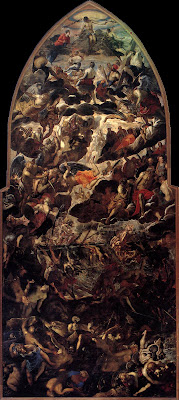
Above his studio door, Tintoretto inscribed “Michelangelo's design and Titian's color.” Titian certainly knew Michelangelo’s 1541 fresco of The Last Judgment and didn’t flinch from the idea of drawing a comparison, just as Michelangelo himself had strove to do Giotto one better. Tintoretto’s The Last Judgment (above, from 1560-1562) stands more than 47 feet high; Michelangelo’s version comes in at a hair under 45 feet. In that slightly larger space, Tintoretto inserts more souls per square foot than his predecessor. Also, Tintoretto depicts the figures greatly foreshortened. Standing at the base of the painting you get the feeling that they are about to fall down on you, as if you had just opened a giant closet door and the entire apocalypse was crammed inside. Giotto’s Last Judgment is pure, coherent order; Michelangelo’s version is complexity masquerading as chaos; but Tintoretto’s take is chaos covering more chaos—perhaps the best rendition of how the final reckoning will actually look to human eyes, if that day should ever come. Perhaps there’s a method to the madness of Tintoretto’s Last Judgment, but the teasing out of the rationale is beyond me. Like so many people trying to keep up with Tintoretto, I just don’t have the energy.


When fires destroyed the decorations of the legislative meeting rooms of the Doge’s Palace, Tintoretto created his largest and last blockbuster, titled with deceptive simplicity, Paradise (detail above, from 1587-1590; see the whole thing here). At 74 feet wide and 30 feet tall, Paradise may be the largest canvas painting ever made. With the help of his son Domenico, the 70-year-old but still spry Tintoretto painted the work and installed it in the room. In the center, Jesus and the Virgin Mary serve as the still center around which hundreds and hundreds of saints radiate out. With Paradise, Tintoretto finishes the job he began with his Last Judgment, showing you the final results, as it were. As with Tintoretto’s Last Judgment, Tintoretto’s Paradise defies easy summation and bursts beyond our ken. One can only wonder what went through the minds of Italian politicians over the years as they deliberated with Tintoretto’s masses teeming on the wall and passing judgment on them as they pass judgment on others. Sadly, Tintoretto’s career is colored by his big thinking and painting. You simply can’t wrap your mind around these works. I suspect that Tintoretto’s point isn’t to stop and think as much as to look and learn, and always, always keep moving.

Monday, April 13, 2009

Power Player


I got a lot of funny looks when I gushed over a portrait by Thomas Lawrence while attending a wedding last November. In an upstairs gallery of the mansion where the wedding took place, a portrait by Lawrence that I had never seen stood beside examples by Joshua Reynolds, Thomas Gainsborough, and Allan Ramsay, reuniting the four greatest British portraitists of the late eighteenth and early nineteenth century. Born April 13, 1769, Lawrence may have been the most talented of the bunch, a child prodigy who started drawing pastels of the patrons of his father’s inn and rose to become painter to first King George III and later King George IV . Lawrence’s portrait of Caroline Amelia Elizabeth of Brunswick (above, from 1804) shows the future queen consort of George IV in younger days. Lawrence alludes to her troubled marriage to the wild Prince Regent by placing her left hand, upon which she wore her wedding ring, in dark shadow. The full extent of Caroline’s marital woes most likely reached Lawrence’s ear during sittings for many portraits over the years. Rumors persist that Lawrence and Caroline even carried on an affair. If so, it was just another self-destructive behavior for Lawrence, who allowed alcoholism and financial irresponsibility to limit how far he could take his gift.


After the defeat of Napoleon in 1815, the Prince Regent IV commissioned Lawrence to paint all the great European heads of state involved in that victory, who had gathered together at the Congress of Vienna. Lawrence painted Pope Pius VII (above) in 1819. Pius VII received credit for fighting Napoleon in the end, although he attended Napoleon’s self-coronation and played ball with the emperor when it suited papal purposes. The real importance of Lawrence’s portrait of Pope Pius VII comes in the amazing fluidity of the drapery and textures. Lawrence recognized the great potential of popish pomp and squeezed every last ounce of juice out of it. Always aware of the history of art, Lawrence measured his achievement against that of Raphael’s Julius II, Titian’s Paul III, and VelázquezInnocent X. Lawrence owned one of the finest collections of Old Master drawings in the world, so the greats of the past were always near at hand. A classicist at heart, Lawrence even helped acquire (for good or ill) the Elgin Marbles for England. Lawrence produced many non-portrait works of great beauty and power, but it was with his portraits that he made his fame and fortune, thus overshadowing the depth of this great, forgotten master.


I like to compare Lawrence with John Singer Sargent. Both owned immense, precocious talent that made their art seem lightweight and all surface with no depth. Both, however, were more than just portraitists of the rich and famous, as scholars now struggle to establish. Lawrence’s portrait of Margaret, Countess of Blessington (above, from 1822) certainly captures the surface flash of her good looks and beautiful finery, but it also reproduces the vivacity of her personally. Host of one of the foremost literary salons of her day, Lady Blessington was much more than a pretty face. The first time I saw a portrait by Lawrence it was this sense of life in the eyes that intrigued me to learn more about him and his art. Sadly, I’ve also seen some lesser Lawrence, including the portrait at that wedding, which seemed a later work, when Lawrence’s light was beginning to dim. It’s amazing to tally up just how much a simple innkeeper son achieved through artistic talent and personal charisma (he almost became an actor!), but even that seems a paltry sum considering just how far he could have gone.

Friday, January 23, 2009

The Great Chain of Being


I’ll confess that I will always find the idea of the Great Chain of Being attractive, despite what post-modernists say. Just call me old fashioned. My mind simply works better when trying to find a connect everything to everything else in a coherent universe, especially when it comes to art. Even someone as game-changing and ground-breaking as Edouard Manet cannot escape the net. Born January 23, 1832, Manet finds himself hailed as the father of modern art, the first artist to break with the old sensibilities and depict modern life as it is, shorn of all falsifying mythology. Manet offered The Luncheon on the Grass (Le déjeuner sur l'herbe) (above, from 1863) as a first glimpse of that brave new world. Yet, how much of this is really new? Art historians point out that Manet “borrowed” the composition from a drawing by Raphael of The Judgement of Paris. The strange, “modern” juxtaposition of dressed and nude figures may have come from Manet’s study of the Renaissance paintings in the Louvre. Sixteenth century works The Pastoral Concert and The Tempest, both likely begun by Giorgione and completed by his student Titian, set the stage for the nineteenth and twentieth centuries. As much as we may want to isolate Manet as a lone genius blazing a trail into the unknown, Manet steps backwards and points to the past to point to the future.


Where The Luncheon on the Grass befuddled, Manet’s Olympia (above), also from 1863, enraged. Manet completely gives up the pretense of mythology as a way of making the female nude acceptable. But how valid was the entire pretense of mythologizing nudes, especially female nudes, to begin with? Again, Manet looked to the Renaissance and Titian, particularly The Venus of Urbino. The gamesmanship of calling a recognizably realistic nude a Venus or Aphrodite and thus giving the painting respectability always seemed a strange gentleman’s agreement. Manet breaks that agreement in Olympia, recognizing that Titian himself most likely never fully signed on either. As “modern” as Olympia appears, her knowing and direct look reflects similar glances in previous artists as well. Goya's Nude Maja, which Manet most likely knew in some form from his study of Spanish paining since Velazquez, challenges the viewer with her eyes more than half a century before Manet’s Olympia does. Manet rejects the idea that confident women comfortable in their skin can only be fictional and simultaneously points back to all the “real” women since the Renaissance.


Manet, however, didn’t turn a blind eye to the art world going on around him. Although he never accepted the label “Impressionist” or agreed to exhibit with the Impressionists, Manet appreciated what the Impressionists were trying to accomplish and became friends with Edgar Degas, Claude Monet, Pierre-Auguste Renoir, Paul Cézanne, and Camille Pissarro. Manet’s Self-Portrait With Palette (above, from 1879) shows Manet trying to keep up with the times and paint in an Impressionist manner himself, momentarily abandoning his clear draftsmanship yet still clinging to his dark, Spanish background. Even more forward-thinking, Manet encouraged women artists Berthe Morisot and Eva Gonzalès when even some Impressionists continued to cling to the all-boys’ club mentality. Manet falls into the cracks between many categories because he doesn’t paint like a true realist and his works are Impressionist in their independent spirit yet not Impressionist in visual style. The inability to lump Manet in with others isolates him. In truth, Manet belongs everywhere, stretching across styles and even across space and time. More than his art, it is Manet’s mind, always searching for new ways of seeing with total disregard for the rules, that helps create the atmosphere in which modern art is born.

Monday, December 1, 2008

Aging Gracefully


While others stoked the fires of the Italian Renaissance in Florence and Rome, Giovanni Bellini set the early standard in Venice until his death on November 29, 1516. Born 1430, Bellini introduced a sensuality and warmth to the religious standards that had become cold and stale over time. His painting of St. Francis in Ecstasy (above, from 1480) places the world-renouncing saint within a beautiful panorama of nature. Although St. Francis of Assisi is shown at the moment of highest communion with the divine, God never “shows his face” in this painting, except in the details of his creation all around Francis. St. Francis almost becomes dwarfed in the larger scheme of nature here, downplaying him and, by extension, all humanity in contrast to the bigger picture of all of creation. Bellini thus gives new life to a familiar standard of religious iconography and actually manages to recreate the original spirit of St. Francis himself, who strove to become attuned to nature and use it as another pathway to God.


One of the dangers of looking through religious art of Renaissance Europe is becoming numb to the similarities not only between works by the same artist but works on the same theme by different artists. All those crucifixions and pietas quickly blur together. That sameness makes the difference of Bellini’s Dead Christ Supported by Angels (Pietà) (above, from 1474) all the more surprising and enjoyable. Bellini’s introduction of angels isn’t new or unique, of course, but he took that twist and twisted it even further, giving the individual angels personality beyond that of stock figure cherubs attending the fallen Christ. The expression on the face of the angel furthest to the right as he muses upon the wound piercing Christ’s left hand captures perfectly the mixture of melancholy and mystery the pieta was designed to invoke in the viewer. You can almost read the psychology on the faces of the other angels depicting an entire range of intensity yet still operating within that same emotional framework.


When Albrecht Dürer visited Venice in 1506 he hailed the 76-year-old Bellini as still the best painter in the city. Bellini drew around him a circle of followers and students, including Giorgione and Titian, who would continue and extend Bellini’s ideas of color and ideal of injecting the personal into public works. As the times changed, Bellini allowed himself to change with them right up to the end. At the age of 85, Bellini painted his first nude female, Naked Young Woman in Front of the Mirror (above, from 1515). Perhaps Bellini had Giorgione’s Sleeping Venus in mind when painting his homage to the female form. Perhaps the freedom to break barriers that Bellini instilled in his students came back to him and freed him in return. Whereas Giorgione “legitimized” his nude with a mythological reference, Bellini’s work shows no bowing to convention. To the end, Bellini believed in the beauty of God’s creation, including that of the human body, as the greatest expression of divine power and, most importantly, divine love.