Showing posts with label Durer (Albrecht). Show all posts

Sunday, April 17, 2011

New Horsemen, New Whores: Michael Caines “Revelations and Dog”


I always chuckle at the old joke about the dyslexic atheist holding up a sign saying, “There is no Dog!” Whenever talk turns to revelations and apocalypses, we all seem to be reading things backwards and upside down in hopes of making sense of the unknown, usually with comic results. Michael Caines’ Revelations and Dog riffs on the familiar song of the Book of Revelation to come up with a new tune for today’s topsy turvy world on the brink. It’s an almost perverse presentation to publish with Easter coming up, but Revelations and Dog’s joking may be the perfect antidote to the humorless, febrile dreams of religious radicalism. Caines comes up with the perfect new Four Horsemen of the Apocalypse and Whore of Babylon for today’s faithful, and unfaithful. Please come over to Picture This at Big Think to read more of "New Horsemen, New Whores."

[Image: Michael Caines, Revelation chapter 6, ink and gouache on paper, 9.5 x 14 inches, 2009.]

[Many thanks to Mark Batty Publisher for providing me with a review copy of and the image from Revelations and Dog illustrated by Michael Caines.]

Sunday, August 1, 2010

Holding On: Edvard Munch’s Prints at the NGA


When you hear the name Edvard Munch, you almost immediately think of The Scream. It’s unavoidable. Even during his lifetime, Munch found himself linked to that image and a select few others from his Frieze of Life series that comprised almost his entire career. Although Munch painted several versions of The Scream, the demand for more overwhelmed the supply. As a solution, Munch turned to printmaking, which allowed fans to have an authentic Munch at an affordable price, while also allowing Munch to capitalize on his fame. But it was much more than pure capitalism that compelled Munch to revisit certain themes and images, as Edvard Munch: Master Prints, now at the National Gallery of Art, Washington, DC, clearly demonstrates. Printmaking allowed Munch to hold on to certain images seemingly forever in a cycle of creation and recreation that made the image and the emotions linked to that image forever new and forever real. Please come over to Picture This at Big Think to read more of "Holding On."


[Image: Edvard Munch. The Lonely Ones, 1899/c. 1917 or later. C
olor woodcut, from one woodblock sawn into three pieces, in black, blue green, yellow, and red with hand coloring on medium cream wove paper. The Epstein Family Collection. © Copyright Munch Museum/Munch Ellingsen Group/ARS, NY 2009.]


[Many thanks to the National Gallery of Art, Washington, DC, for providing me with the image above and a review copy of the catalogue to Edvard Munch: Master Prints, which runs through October 31, 2010.]

Wednesday, July 15, 2009

Brief Hiatus


Because of family responsibilities and schoolwork, Art Blog By Bob has been and will continue to be on temporary hiatus until most likely the beginning of August. Until then, please feel free to wander through the archives and to picture me living the life of a scholar and praying to the patron saint of scholars, Saint Jerome, shown above in Albrecht Durer’s Saint Jerome in his Study (from 1514). Enjoy your summer!

Tuesday, July 7, 2009

Madman Across the Water


In May 1809, William Blake set up an exhibition of his works in a room above his brother’s hosiery shop in the house in which he was born and raised. Few people came to see the sixteen oddly beautiful works hung there, fewer picked up the Descriptive Catalogue Blake has written and printed to help explain his works, and even fewer bought anything. The sole review of the show published in The Examiner called the paintings “the wild effusions of a distempered brain.” Visitors straggled through as late as June 1810 to see the works. The length of the exhibition, however, marked not public interest but Blake’s own disappointment and wish to forget the hanging entirely. Two centuries later, the Tate Britain has recreated Blake’s failed show in an exhibition and Martin Myrone resurrects Blake’s weird and wonderful catalogue in William Blake’s Seen in My Visions: A Descriptive Catalogue of Pictures. Through Myrone’s scholarly introduction and editing of Blake’s own effusions, we can travel back in time to see works such as Blake’s The Spiritual Form of Nelson Guiding Leviathan (above, from 1805-1809) as Blake’s contemporaries may have seen them. Myrone paints Blake’s 1809 fiasco as a turning point in the poet-artists’ career in which the Blake we have come to know and love today is seen as just one of the many possible “Blakes” that could have come down to us.


Blake always thought on a cosmic level, and this exhibition aimed no lower. In his introduction, Myrone calls Blake’s 1809 exhibition “not merely a celebration of an artist’s work, a straightforward retrospective of a career, but an agenda-setting, forcefully polemical intervention into the art world, and an enterprise aimed at reforming not only the tastes of the public, but their morality as well, through the revival of the ‘grand style’ in art.” In Blake’s black and white world of art and morality, Michelangelo, Raphael, and Durer emerge as the heroes of the grand style, whereas Titian, Rubens, Correggio, and Rembrandt represent the weaker elements that have cheapened art and drained the energy from public morality. Blake specifically challenged the art and morality of his time by “calling out” artists, including one-time friend Thomas Stothard, by interpreting subjects in his own “grand style” way. Blake’s The Canterbury Pilgrims (above, from 1808) challenges the more conventional rendering of Stothard by going bigger and bolder and attempting to convey the human drama embedded in Chaucer’s famous work. “He who does not imagine in stronger and better lineaments, and in stronger and better light than his perishing mortal eye can see,” Blake writes in his catalogue, “does not imagine at all.” Anyone who loves Blake’s almost superhuman confidence in his poetry will eat up similar brashness in the catalogue. When Blake decries other artists “laboring to destroy Imaginative power, by means of that infernal machine, called Chairo Oscuro,” it’s easy to forget that Caravaggio, the king of chiaroscuro, languished in near obscurity in the 1800s, remembered mostly through his imitators. I also wonder what Blake’s friend, Henry Fuseli, himself a fan of chiaroscuro’s effects, may have thought of Blake’s “infernal” judgment. Blake never pulled his punches. Seen in My Visions allows you to step in the ring with the poetic pugilist for as many rounds as you can stand.


Of the sixteen works shown in 1809, eleven survive, including Blake’s The Soldiers Casting Lots for Christ's Garments (above, from 1800). The survivors show Blake’s work in tempera on canvas and watercolor on paper. Blake disdained oil painting as a symptom of art’s decline. Fresco, the medium for Michelangelo and Raphael, was forever, and Blake desired nothing less than eternity. In 1809, Blake still imagined a place in the mainstream art world for himself. None of the works shown in 1809 relate to the poetry Blake was writing and would later illustrate himself, gaining the fame he now enjoys posthumously. Chaucer, Thomas Gray, and the Bible provided the subject matter for Blake’s art. I found it difficult imagining a “Blake” different than the “Blake” I know so well, but Myrone convincingly argues for the possibility of at least one “Blake” that could have been. One of the lost works, titled Ancient Britons and standing at 3 meters high by 4 meters long, broke all the rules of what a “Blake” is known as. “A privately commissioned painting on a serious historic subject, painted in a severely classical style, full of patriot feeling, and completed on a very large scale,” Myrone describes Ancient Britons from the surviving clues. “If the picture had survived, our image of Blake might be quite radically different: he would be placed even more readily in the company of [James] Barry and Fuseli than he is now.” Would such a “Blake” be better or worse? If Ancient Britons were to reemerge from obscurity tomorrow, would the familiar “Blake” of soaring visions and stubborn independence be lost for good?


In the end, however, despite dreams of a parallel universe in which Blake and James Barry sit cozily beside each other in a prosaic list of painters of the period, we are left with the only Blake we know. After the failure of the 1809 show, Blake turned his back on the conventional art world. He participated in only one more exhibition in 1812. When Sir Joshua Reynolds, official tastemaker of Blake’s time and gatekeeper for artistic success, published his lectures, Blake annotated them with the bitter marginalia of a outsider with no hope of finding his way in. Seen in My Visions shows Blake at his visionary best, especially in works such as Christ in the Sepulchre, Guarded by Angels (above, from 1805), but also at his pragmatic best, wishing for a way to become an insider without compromising his principles so as to better art and society from within the machinery itself. Even Blake knew that access to the inner workings of the system was the only way to change it. Denied the chance even to touch the levers of power, Blake forged a different path, lighting a long fuse for an artistic and philosophical bomb that would take decades to detonate and contribute to change. Even two centuries later, Blake explodes in our imaginations like few other artists. The exhibition and catalogue Seen in My Visions shows that Blake didn’t begin as a bomb thrower into the future.


[Many thanks to Tate Publishing for providing me with a review copy of William Blake’s Seen in My Visions: A Descriptive Catalogue of Pictures, edited by Martin Myrone.]

Thursday, May 21, 2009

Superstar


The long and often tragic history of Germany is tied up in large part with an identity complex. Like many European countries, the idea of Germany as a country with clear borders is a relatively modern one. Wars and kingships have moved borders back and forth so often that what was German land and what wasn’t remained an enduring question. In the late nineteenth century, Germany tried to fill this identity void by creating truly Germanic heroes. In the world of art, Albrecht Durer was crowned the first and truest German superstar. Born May 21, 1471, Durer brought the Italian Renaissance north, where it became the Northern Renaissance. Yet, just as Germany itself was a work in progress, Durer had to grow into his superstardom. The Self-Portrait of 1493 (above) shows the 22-year-old Durer at the beginning of his career, just starting to travel across Europe to accrue the mixture of influences that would inspire his mature work. Durer painted this self-portrait in Basel and shipped it back to his intended back in Nurermberg, writing “Things with me fare as ordained from above” at the top of the picture. From the very beginning, Durer sensed his fate was in God’s hands.


Just five years after painting the awkward Self-Portrait of 1493, Durer paints the self-assured Self-Portrait of 1498. Durer now sits up straighter than before. Whereas the 1493 portrait is isolated, the 1498 portrait includes a window onto the world. Durer had just returned from Venice with the Italian Renaissance still fresh in his mind. The world had literally broken wide open for Durer in the span of just five years. Legend has it that Durer’s dog barked and wagged his tail upon seeing the 1498 portrait for the first time, fooled into thinking it was actually his master. The realism of this portrait as well as the opulence of the clothing Durer wears show that Durer had mastered the techniques of the Renaissance masters and was turning a fine profit for himself. Yet, Durer remains turned slightly away, as if he can’t yet bring himself to face the viewer full on. His mission was not yet complete.


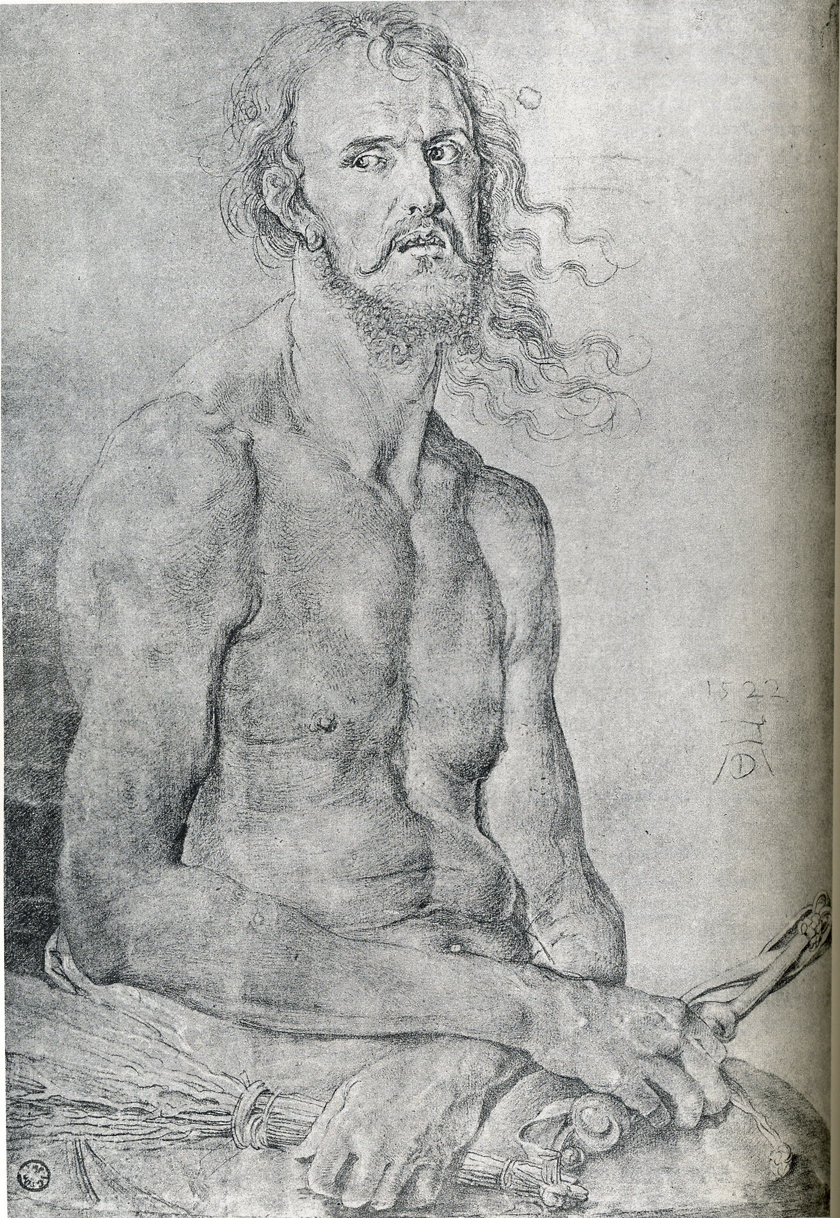
In the final painted Self-Portrait of 1500 (above), Durer faces the viewer directly in total confidence of his powers. He wears kingly clothing and his hair cascades down like a lion’s mane, proclaiming him the king of the German cultural jungle. Durer assumes visually the mantle of the King of Kings, Christ himself, in this final self-portrait not out of blasphemous braggadocio but instead to illustrate how the artist imitates God himself in the creative act. If imitation is the sincerest flattery, Durer imitates Christ to praise him as the source of all artistic and creative power. In a 1522 drawing, Durer lent his features to Christ again, but this time as the Man of Sorrows instead of Christ triumphant. As age began to take its toll on Durer, he identified increasingly with the Suffering Servant side of Christ’s story, recognizing that his ascension to the rank of creator had ended. Of all the artists in different media adopted by the Nazis at the apex of German nationalism, Durer and perhaps Beethoven seem to be the two left untainted by that association. As the German Expressionists recognized (especially Ernst Ludwig Kirchner, who fashioned himself a modern-day Durer through his own self-portraiture), the stellar light of a superstar such as Durer can never be tarnished by mere mortals.

Thursday, May 7, 2009

Man on the Street


Life in the big cities of Germany inspired Ernst Ludwig Kirchner like no other artist of his time. Born May 6, 1880, Kirchner helped found Die Brücke in 1905 along with three other students in Dresden. Kirchner painted Street, Dresden (above) initially in 1908, when Brucke was at its height, but continued to return to make changes up to 1919, long after Brucke had moved on to Berlin in 1911 and even after Brucke disbanded in 1913. Kirchner’s style exemplifies German Expressionism for me, taking the facts of a simple street scene and imposing the vision of the artist upon it. Whenever you see well-dressed women in a Kirchner streetscape, you’re most likely safe in assuming they are prostitutes hawking their wares. The way Kirchner outlines the orange hat of the woman in the foreground with even brighter orange highlights makes me think of a neon sign in its garish, commercial advertising feel. The formless faces in Street, Dresden resemble those of Edvard Munch’s 1892 painting, Evening on Karl Johan Street. Kirchner and the other Brucke artists idolized Munch and even unsuccessfully invited him to join their group. In Street, Dresden, Kirchner captures much of the Munchian sense of alientation and unease.


By the time that Kirchner had painted Friedrichstrasse (above, from 1914), Brucke was over and he was ensconced in Berlin, a city much more international and cosmopolitan than the still-medieval looking Dresden. Kirchner paints Friedrichstrasse in a series of slashing lines, conveying a sense of endless movement similar to the Italian Futurists painting at the same time. The women, again, are most likely prostitutes. The pattern I’ve noticed in Kirchner’s art is that the naked figures are usually young and innocent, whereas the older, fashionably dressed women are far from innocent. Kirchner sets up that opposition to dramatize what he saw as the deadening and corrupting effect of modern civilization. Like Gauguin, Kirchner saw a simplicity and honesty in the art and lifestyle of Oceanic cultures and mimics their art in the angularity of his own. But even that angularity falls into two categories in Kirchner’s world—youthful innocence is simplified into flat planes and colors, rejecting all painterly illusion, whereas aged corruption becomes sinister in the sharp lines of faces and bodies that threaten to cut you like a knife.


In Potsdamer Platz (above, from 1914), Kirchner merges his Munch-like instincts with his primitivism (although the two are certainly not mutually exclusive). The bodies and faces scream Munch, but the harsh angles of Kirchner’s later development appear. The street itself, however, now seems to shift and move, devolving into a nightmare landscape. World War I loomed on the horizon, and Kirchner volunteered to serve at its beginning. By 1915, a total breakdown left him unfit to fight. Kirchner channeled his anguish into even greater Expressionist works. He came to see himself as the heir to the mantle of greatest German artist, following in the footsteps of Albrecht Dürer and Lucas Cranach the Elder. Sadly, the Nazis in their rise to power redefined what constituted German-ness. Kirchner, the self-styled most German of artists, found himself and his work excluded from German museums and collections as part of the “Degenerate Art” declamation. After watching much of his art either destroyed or sold away, Kirchner took his own life in 1938. If Kirchner had been French, he would have been called a flaneur, a connoisseur of street life mingling among the people and diagnosing the ills of society. But, alas, Kirchner’s German roots not only provided his richest material but ultimately spelled his doom.

Tuesday, April 28, 2009

Bridge Over Troubled Waters

Erich Heckel (1883-1970). Landscape in Dresden (Landschaft bei Dresden), 1910. Oil in canvas, 66.5 x 78.5 cm (26 1/8 x 30 7/8 in.). Staatliche Museen zu Berlin, Neue Nationalgalerie

“What is great in man is this: that he is a bridge and not an end,” wrote Friedrich Nietzsche in Thus Spoke Zarathustra in 1885. Two decades later, on June 7th, 1905, four young architecture students in Dresden, Germany, may have had those words in mind when they founded the artists group known as Die Brucke, or “The Bridge.” Ernst Ludwig Kirchner, Karl Schmidt-Rottluff, Erich Heckel, and Fritz Bleyl thus began an artistic movement that would stage more than seventy exhibitions before their disbanding in 1913, with twenty-seven happening in 1907 alone. “By joining together into a small, cohesive community with common goals, the Brucke artists hoped to stand up to [the] putatively fragmenting, debilitating effects of modern urban life,” writes Reinhold Heller in his essay “Brucke in Dresden and Berlin, 1905-1913” in Brucke: The Birth of Expressionism in Dresden and Berlin, 1905-1913, the catalogue to the current exhibition at the Neue Galerie in New York City. This exhibition, the first major exhibition of the Brucke in the United States, resituates these artists at the very beginning of the modern, international art world as they reached beyond Germany’s borders and invited the likes of Norwegian Edvard Munch (unsuccessfully) to join their band. “By reaching out, whether successfully or not, to such revolutionary painters,” Heller continues, “the Brucke established a network of communication with Europe’s most progressive artists and art institutions.” Dresden, known as “Florence on the Elbe” and famous for its many bridges (one of which is captured in Erich Heckel’s Landscape in Dresden, above, from 1910), thus became the starting point for the bridge-building across borders and between individual artists that the modern art world has become today.


Erich Heckel (1883-1970). Studio Scene (Atelierszene), 1910-11. Oil on canvas, 70 x 48 cm (27 1/2 x 18 7/8 in.). Nachlass Erich Heckel, Gaienhofen.

In addition to their unsuccessful wooing of Munch, the Brucke successfully brought other artists, such as Emil Nolde and Max Pechstein into their fold. Staging group exhibitions and developing a signature style for their promotional material, the Brucke artists created a template for later artistic groups to follow. In all things, however, the Brucke set out to stand apart from the flow of contemporary, mainstream German life. They embraced “primitive” Indian, Oceanic, and African art, following in the footsteps of heroes such as Van Gogh and Gauguin and their search for primal forces untainted by modernity’s touch. This primitive approach, especially to the human figure, appears throughout their work, including Heckel’s Studio Scene (above), which also accurately depicts the everyday existence of the Brucke. For the Brucke artists, work and life were inseparable and models became friends and, sometimes, lovers. The artists even provided a “ruheraum” or “room of rest” for the models away from the labor of modeling. The German government’s crackdown on erotic images made the nude images of the Brucke artists all the more daring and avant-garde. In a musty old world suddenly thrown into an industrial age, the Brucke artists painted themselves as outlaws belonging to neither, but rather inhabitants of their own bohemian sphere of equality, fraternity, and, above all, beauty.


Ernst Ludwig Kirchner (1880-1938). Marzella (Fränzi), 1909-10. Oil on canvas, 76 x 60 cm (29 7/8 x 23 5/8 in.). Moderna Museet, Stockholm.
In the midst of this cultural separation, however, the Brucke longed to reconnect with what they saw as the essence of German art. Surrounded by the medieval art treasures of Dresden, the Brucke artists embraced forefathers such as Albrecht Dürer, Matthias Grünewald, and Lucas Cranach the Elder. Kirchner fashions himself as a modern Durer, who becomes “the German cultural hero” for the entire group, according to Christian Weikop in his essay, “Brucke and Canonical Association.” Nolde champions Grunewald as embodying “Nolde’s anti-academic, anti-Renaissance position,” Weikop writes. When Kirchner paints nude figures such as his Marzella (above, from 1909-1910), he channels Cranach’s approach to the nude. Kirchner elsewhere goes so far as to quote directly some of Cranach’s nudes, building a bridge across the centuries using the female form as building material. “Dresden offered much inspiration,” Weikop writes. “Here… Brucke found its first art historical corroboration in Cranach, [Sebald] Beham, and other German masters of the Middle Ages.” The Brucke even resurrected the quintessentially German medium of the woodcut as a way of recalling the past to get back to the future of art. When the Nazis debated on how to judge the Brucke in the days of the “Degenerate Art” exhibition, Joseph Goebbels and others argued for the Germanness of the Brucke, but Hitler ultimately overruled them.


Ernst Ludwig Kirchner (1880-1938). Berlin Street Scene (Berliner Strassenszene), 1913-14. Oil on canvas, 121 cm x 95 cm (47 5/8 x 37 3/8 in.). Neue Galerie New York and Private Collection, New York.

Despite this German self-identification, the Brucke continually looked beyond national borders. Jill Lloyd’s “Brucke: National Identity and International Style” examines the tension between these nationalist and internationalist impulses. Dresden exhibitions of Van Gogh’s work in 1905 and Munch’s work in 1906 bring the cutting edge of art right to the Brucke’s doorstep. (The Neue Galerie’s Van Gogh and Expressionism exhibition in 2007 [my review here] covered that link extensively.) Lloyd sees the Brucke’s taking in of these influences not as “slavish dependence” but rather as “transformation[s].” Comparing the Brucke with their contemporaries, the Fauves, Lloyd writes, “Whereas the French artists worked within an established national tradition, the Germans pursued a self-conscious internationalism that went beyond the formulation of a new expressive style.” Criticism of the Brucke for not being “German” enough drove them in 1911 from Dresden to the more international city of Berlin. Berlin was the hub of the international art market at the time and provided easier access to the rest of the art world. In Berlin, Lloyd writes, the Brucke could “build more consciously on the elements of ‘Germanic’ or ‘Gothic’ style that had always co-existed with their modernism.” Kirchner’s Berlin Street Scene (above, from 1913-1914) shows how he adapted to his new, more cosmopolitan surroundings.

Karl Schmidt-Rottluff (1884-1976). Corner of a Park (Parkecke), 1910. Oil on canvas, 83.5 x 75.5 cm (32 7/8 x 29 3/4 in.). Pinakothek der Moderne, Munich.

By 1911, however, the Brucke artists were beginning to grow apart. When Kirchner writes his chronicle of the movement and casts himself as the leader, Schmidt-Rottluff (whose Corner of a Park appears above, from 1910) and others take offense and finally disband in 1913. As Rose-Carol Washton Long explains in her essay, “Brucke and German Expressionism: Reception Reconsidered,” the Brucke soon drifted to the margins of art history for being not “modern” enough or not “political” enough. Only in the last twenty years, when “modernism” has been redefined as “one of the conflicting products of change in an industrial society,” Long writes, have the Brucke been rediscovered as an essential step in the progress of modern art. Brucke: The Birth of Expressionism in Dresden and Berlin, 1905-1913, the catalogue and exhibition, not only brings this neglected school to American shores for the first time, but also allows them to resurface from the depths of art history obscurity. Rather than being just a poor relation to Der Blaue Reiter, Die Brucke helped shape the international art world as we know it today in all its jet-setting internationalism. Able to embrace both their own national heritage and those of other civilizations, the Brucke artists set an example that artists continue to follow today, even if they don’t know where, how, or why it began. The Neue Galerie’s exhibition will answer all those questions, and more.

[Many thanks to the Neue Galerie for providing me with a review copy of Brucke: The Birth of Expressionism in Dresden and Berlin, 1905-1913 and for the images above from the exhibition.]

Tuesday, March 31, 2009

Taxing Times


Now my advice for those who die,
Declare the pennies on your eyes.
‘Cause I’m the Taxman,
Yeah, I’m the Taxman.

And you’re working for no one but me.

—From “Taxman” by The Beatles

For the March Art Poll By Bob, I asked you to rock out and answer the following question, “Which of these famous statues of antiquity makes you get all old school?” You picked the Nike of Samothrace (3rd century BCE) over Laocoon and his Sons (2nd or 1st century BCE) 17 to 16. Dying Gaul (3rd century BCE) came in third with 10 votes, just ahead of the Venus de Milo (2nd century BCE) with 9. The Barberini Faun (3rd century BCE) held fifth place by itself with 5 votes, while Antinous Mondragone (130 CE), Apollo Belvedere (4th century BCE), Belvedere Torso (2nd century BCE), and Farnese Hercules (3rd century CE) shared a four-way tie for sixth place with a single vote each. Satyr or Faun of Praxiteles (2nd century BCE) brought up the rear with 0 votes. Thanks to everyone who played along.

For April, in honor of the United States looming tax return deadline on April 15th, I’ve decided to ask the following question, “Which of these following money- or tax-related works brings you the most to account?”:


Hieronymus Bosch. Death and the Miser (1490s).


Caravaggio, The Calling of Saint Matthew (1599-1600).


Lucas Cranach the Elder. Christ Drives the Usurers out of the Temple (1517).


Albrecht Dürer (attributed). Of Usury, from Brant's Stultifera Navis (the Ship of Fools) (1494).


John Leech. Ebenezer Scrooge and the Last of the Spirits from Charles Dickens's A Christmas Carol (1843).


Quentin Matsys. The Moneylender and his Wife (1514).


Rembrandt. Christ Driving the Moneychangers from the Temple (1626).


Niels Larsen Stevns. Zacchaeus (1913).


Thomas Sully. Shylock and Portia from Shakespeare's The Merchant of Venice (1835).


Paul Vos, The Tax Collector (1543).

No complicated forms, W2s, or math involved—just sum up the energy to pick your favorite. Unlike the IRS, I’ll even give you until the end of the month to file. Don’t be greedy, just vote for your favorite.

Monday, January 26, 2009

Visionary Company


What could it have been like for a young artist to meet William Blake in person? Intimidating, inspiring, invigorating, all of the above, and more. Through the engraver John Linnell, who would one day become his father in law, Samuel Palmer met Blake in 1824 and was never the same. Born January 27, 1805, Palmer became the one true disciple of Blake’s style. Blake’s Illustrations of the Book of Job stuck in Palmer’s visual memory for the rest of his life, coloring his perception of nature through their depiction of the pastoral landscape. Palmer eventually superimposed those Blakean landscapes onto the vistas surrounding his home in Shoreham, England, such as Garden in Shoreham (above, from 1820-1830). The garden here literally explodes with fertility, with the top of the tree resembling a mushroom cloud after a nuclear detonation. Palmer releases the energy of the atom in such scenes, taking mundane scenery and making it represent the vastness of the cosmos. Palmer tuned in to Blake’s message before tuning in on Blake was cool.


Before meeting Blake, Palmer lived with his father in London and frequently visited the British Museum to study the prints of Albrecht Durer and other masters. This study not only helped further Palmer’s draftsmanship, but also showed him the potential of working in monochrome. Palmer’s A Rustic Scene (above, from 1825) is a watercolor done entirely in shades of brown, which adds to the rustic quality of the image. The brown lends the scene and earthiness that vibrant color might not. Late in his career, Palmer worked heavily in engravings, becoming so demanding in his perfectionism that one printer claimed he rather see the devil walk through his door than Palmer with a handful of corrections to be made. It’s amazing to think of the diversity of Palmer’s eye when you place works such as Garden in Shoreham next to A Rustic Scene.


After Blake’s death, Palmer assumed the mantle of the “visionary” artist in England, the cult figure around which younger artists would gather. A group of young artists calling themselves the Ancients that once surrounded Blake now surrounded Palmer. They longed to be initiated into the spiritual clique that produced such works as Palmer’s Harvest Moon, Shoreham (above, from 1830-1831). Because of earlier criticism of his Shoreham paintings, Palmer refused to exhibit them and only allowed this select society to see them. Many of these works went unseen by the public until the twentieth century. Some were actually destroyed by Palmer’s son, who thought them too feminine and feared they would harm his father’s reputation. Today, modern artists see Palmer’s penchant for color and highly charged landscape as amazingly prescient, just as Blake himself seemed born much too early. Thanks to several museum exhibitions in the last few years, Palmer’s reputation as a great artist in his own right has helped bring him and his artwork out of the considerable shadow of Blake.

Monday, December 1, 2008

Aging Gracefully


While others stoked the fires of the Italian Renaissance in Florence and Rome, Giovanni Bellini set the early standard in Venice until his death on November 29, 1516. Born 1430, Bellini introduced a sensuality and warmth to the religious standards that had become cold and stale over time. His painting of St. Francis in Ecstasy (above, from 1480) places the world-renouncing saint within a beautiful panorama of nature. Although St. Francis of Assisi is shown at the moment of highest communion with the divine, God never “shows his face” in this painting, except in the details of his creation all around Francis. St. Francis almost becomes dwarfed in the larger scheme of nature here, downplaying him and, by extension, all humanity in contrast to the bigger picture of all of creation. Bellini thus gives new life to a familiar standard of religious iconography and actually manages to recreate the original spirit of St. Francis himself, who strove to become attuned to nature and use it as another pathway to God.


One of the dangers of looking through religious art of Renaissance Europe is becoming numb to the similarities not only between works by the same artist but works on the same theme by different artists. All those crucifixions and pietas quickly blur together. That sameness makes the difference of Bellini’s Dead Christ Supported by Angels (Pietà) (above, from 1474) all the more surprising and enjoyable. Bellini’s introduction of angels isn’t new or unique, of course, but he took that twist and twisted it even further, giving the individual angels personality beyond that of stock figure cherubs attending the fallen Christ. The expression on the face of the angel furthest to the right as he muses upon the wound piercing Christ’s left hand captures perfectly the mixture of melancholy and mystery the pieta was designed to invoke in the viewer. You can almost read the psychology on the faces of the other angels depicting an entire range of intensity yet still operating within that same emotional framework.


When Albrecht Dürer visited Venice in 1506 he hailed the 76-year-old Bellini as still the best painter in the city. Bellini drew around him a circle of followers and students, including Giorgione and Titian, who would continue and extend Bellini’s ideas of color and ideal of injecting the personal into public works. As the times changed, Bellini allowed himself to change with them right up to the end. At the age of 85, Bellini painted his first nude female, Naked Young Woman in Front of the Mirror (above, from 1515). Perhaps Bellini had Giorgione’s Sleeping Venus in mind when painting his homage to the female form. Perhaps the freedom to break barriers that Bellini instilled in his students came back to him and freed him in return. Whereas Giorgione “legitimized” his nude with a mythological reference, Bellini’s work shows no bowing to convention. To the end, Bellini believed in the beauty of God’s creation, including that of the human body, as the greatest expression of divine power and, most importantly, divine love.