Showing posts with label Rouault (Georges). Show all posts

Wednesday, August 25, 2010

Thumbs Up: Reconsidering Jean-Léon Gérôme


If you think that a thumbs up in ancient Rome meant that the beaten gladiator would live and that a thumbs down meant death, you can thank Jean-Léon Gérôme’s 1872 painting Pollice Verso (shown above) for that. In reality, thumbs down meant “stick your sword in the ground” and no kill. Thumbs up meant “stick the sword in his neck.” It’s amazing to think of how a single work could generate such a widespread idea, but Gérôme enjoyed that kind of influence in the nineteenth century thanks to hi show-stopping scenes of the ancient world and exotic east. As tastes shifted towards modernism with the turn of the twentieth century, Gérôme slid into obscurity. Reconsidering Gérôme, edited by Scott Allan and Mary Morton, accompanies The Getty Center’s exhibition, The Spectacular Art of Gérôme, in trying to restore Gérôme’s good name in today’s art world. Their efforts amount to one big thumbs up for an artist whose old-fashioned realism masks modernist impulses that make Gérôme’s art relevant today. Please come over to Picture This at Big Think to read more of "Thumbs Up."


[Image: Jean-Léon Gérôme. Pollice Verso, 1872. Oil on canvas, 39.5 x 58.6 cm (15.5 x 23 in.). Phoenix Art Museum. Museum purchase.]


[Many thanks to Getty Publications for providing me with a review copy of Reconsidering Gérôme, edited by Scott Allan and Mary Morton. The Spectacular Art of Gérôme continues at the Getty Center through September 12, 2010.]

Thursday, May 28, 2009

Passion Play


Working as a teenager as apprentice to a glass painter and restorer, Georges Rouault came face to face daily with beautiful stained glass windows showing scenes of the life of Christ. Born May 27, 1871 to a poor, pious Parisian family, Rouault’s faith was always strong, but it was his friendship with the philosopher Jacques Maritain that drove Rouault to commit himself to painting primarily religious subjects. Rouault’s The Flagellation (above, from 1915) shows the lingering influence of stained glass window design in the cloisonnist dark lines separating the fields of color. Christ stands at the pillory in the center of the work to take the blows of the soldiers. World War I raged as Rouault painted this scene of suffering, which may allude to Europe’s self-flagellation in the name of nationalism. It is interesting that Rouault’s works concentrate almost exclusively on the passion and death of Christ, with no images that I know of depicting the triumph of the Resurrection. Rouault identified with agony more than ecstacy, saying once, “The conscience of an artist worthy of the name is like an incurable disease which causes him endless torment but occasionally fills him with silent joy.” Perhaps Rouault allowed himself a moment of “silent joy” upon completing The Flagellation, but the emphasis was definitely on the silence.


In 1920, Rouault painted The Crucifixion (above) in the same stained-glass style with the same contorted limbs. The Fauves claim Rouault as one of their own for his bold use of color. The Expressionists count him among their ranks for Rouault’s tortured rendition of the human body, usually Christ’s. Certainly Emil Nolde’s 1912 Prophet equals the religious fervor and Expressionist angst of Rouault’s religious works. I find it fascinating that Rouault paints Jesus in The Crucifixion without a beard, whereas other works show the familiar bearded face. Michelangelo chose to paint the Savior of The Last Judgment as a beardless youth to allude to the Greek ideal, casting Christ as a new Apollo bringing light into the world. I’m not sure that Rouault shared Michelangelo’s same faith in humanism, especially in 1920, when the aftershocks of the Great War continued to be felt throughout Europe. Maybe Rouault paints Jesus here as the beardless youth to stand for the whole generation of beardless European youth that met their end in the trenches and fields of wartime folly.
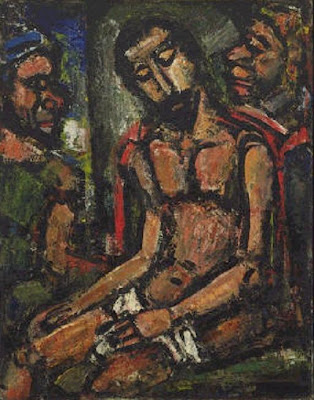


Before Rouault turned his attention to Christ-centered paintings, he painted series of works showing clowns, kings, and prostitutes as a way of commenting on the sad state of modern society. In Christ Mocked by Soldiers (above, from 1932) Rouault shows Jesus at the moment he is forced to play the clown king for the amusement of the soldiers, who crown him with thorns and place a reed “scepter” in his hands. In Christ Mocked by Soldiers, Rouault mocks the world itself, which he sees as prostituting itself for material things at the expense of its soul. “The richness of the world, all artificial pleasures,” Rouault lamented, “have the taste of sickness and give off a smell of death in the face of certain spiritual possessions.” By 1932, Rouault may have recognized, as did many others, the degenerating situation in the world that would eventually lead up to World War II. Rouault returns to the image of the bearded Christ here to emphasize the weariness of age rather than the innocence of youth of The Crucifixion. In his sixties himself, Rouault grew weary of the world and its self-destructive ways. Shortly before his death in 1958, Rouault destroyed three hundred of his own paintings, which would be worth a fortune today, as if to place them on his own funeral pyre and out of the reach of the materialists who valued them in currency instead of, as he did, in Christianity.

Friday, October 24, 2008

Late Bloomer


“I was twenty-one before I saw a good picture,” Sir Matthew Smith once said of his insular upbringing in the shadow of his pious, businessman father. Born October 22, 1879, Smith eventually resisted his father’s attempts to place him in the world of business and, despite ill health, willed himself into the world of art. In 1908, Smith traveled to France to study at the Slade, the art school run by Henri Matisse. Although he most likely didn’t study directly with Matisse, Matisse influenced the entire curriculum of the school. Smith’s Dulcie (above, from 1915) shows how he took the style of Matisse in his Fauvist days and adapted it to his own uses. The connection with Matisse opened up doors to Smith that allowed him to exhibit with the likes of Matisse, Kandinsky, Fernand Léger, and Georges Rouault all before World War I erupted and forced Smith to return to England. Because of this influence of Matisse, Smith seemed “more French than English” upon his return, according to one contemporary, in terms of his handling of color to elicit emotion. Smith neatly smuggled Matisse across the Channel and overnight opened the eyes of his countrymen to the next big thing in painting.


Within a few years of returning to England, Smith found himself drafted into the war. He suffered shrapnel wounds in combat that taxed his already frail health, but the experience of war exacted a greater toll on his mind, beginning a cycle of creativity alternating with depression that would plague the rest of his life. Smith eventually established a London studio near that of Walter Sickert, whose (in)famous “Camden Town” nudes set the standard for the nude form in English painting in the early twentieth century. In Model Turning (above, from 1924), Smith slowly turns away from Matisse’s influence and turns toward a style closer to that of Sickert’s. The red skirt and blue and purple cushions hark back to Fauvism, but the instability of the figure itself generated by the roughness of the brushwork is pure Sickert. Actually, Smith exceeds even Sickert’s penchant for molding the figure in color like a sculpture rather than through line.


Smith continued to progress in a more Sickert-esque direction. In one of his many portraits of his friend and fellow painter Augustus John (above, from 1944), Smith handles the subject roughly. John referred to his portrait as “another hemorrhage for Matthew” in acknowledgment of the bloody, gory way Smith painted flesh even in the portraits of friends. As the pace of his cyclical depression increased, Smith’s view of life and humanity seemed to darken considerably. The young Francis Bacon admired Smith’s troubled style and patterned his own work after it. In many ways, Smith is the link between Sickert and Bacon, the two most important painters of the nude in English painting in the twentieth century. Smith’s evolution from Fauvism, one kind of beastliness, to the later brand of beastliness in his final works demonstrates how the late bloomer more than made up for lost time.